Table of Contents
Digital marketing changed forever when big companies began blocking tracking cookies. For a long time, brands relied on web browser spying to figure out what people wanted to buy. Today, that method is broken. Users do not want companies tracking their every move across the web. Because of this privacy shift, smart businesses are looking for new ways to talk to their audience. One of the best places to find honest feedback is on the Fediverse.
The Fediverse is a network of independent social media servers that talk to each other. Mastodon is the biggest platform in this network. When you want to gather information from this community, using mastodon polls is the most effective method available. This tool allows you to gather clean data without violating anyone’s privacy.
The tool we are focusing on is built right into the platform. You do not need a special account or expensive software to use it. When you create a post, you can add a set of choices for your followers to click. These mastodon polls give you a direct line to consumer opinions. You are not guessing what your audience likes based on algorithms or hidden tracking codes. Instead, you are asking them direct questions. They give you direct answers. This type of information is called zero-party data. It means the user is giving you their preferences freely and knowingly.
The core promise of this strategy is speed and agility. In the modern business world, you cannot wait three months for a costly marketing firm to write a report. You need to know what features your users want right now. By mastering mastodon polls, you can test ideas in minutes. You can ask your community which product colors they prefer, what software features they need, or what blog topics they want to read. The responses come back in real time. This guide will show you exactly how to set up, design, and share these surveys to get the best results for your brand.
How to Set Up Mastodon Polls
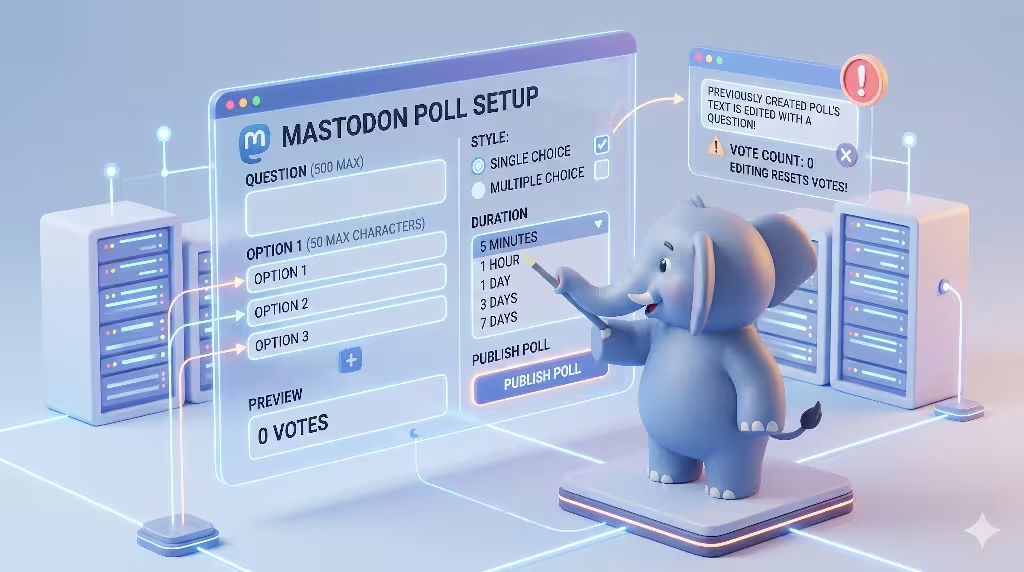
Before you can gather any data, you need to understand how the software works. To start, log into your account using the web interface on your desktop computer. Look at the post composer box where you normally type your status updates. At the bottom of that box, you will see a small icon that looks like a three-bar graph. Clicking this graph icon will reveal the settings for mastodon polls.
Once you click the icon, the entry form will change. You will see blank lines where you can type your poll options. By default, the system gives you two blank options, but you can click an add button to create up to four choices. Each choice has a strict limit of fifty characters. This means your choices must be short and direct. You cannot write long, rambling sentences for your options. You must get straight to the point. If your server runs a modified version of the Mastodon software, you might see more than four options, but the standard network limit is four.
Next, you must choose the style of your survey. Look for a dropdown menu labeled Style. It gives you two main choices. The first choice is Pick One, which sets up a single-choice vote. Users can only select one button. The second choice is Multiple Choice. This turns the radio buttons into checkboxes. When you use multiple choice settings on mastodon polls, users can check as many answers as they want. This is very useful when you want to see all the different tools a customer uses rather than just their single favorite tool.
You also need to set a time horizon. This determines how long your vote stays active. The system allows you to choose a wide range of durations. You can set the timer to expire in five minutes, thirty minutes, one hour, six hours, one day, three days, or seven days. For deep market research, you should usually choose seven days. This gives users across different time zones enough time to see your post and submit their answers.
There is a major catch when you use mastodon polls that trips up many digital marketers. You cannot attach files like pictures, videos, or audio clips to the same post that holds a poll. The system will not allow it. If you try to upload a photo of a new product design, the poll button will become unavailable. If you click the poll button first, the photo upload button stops working.
To get around this problem, you must use a method called threading. First, write a post that contains your images or media files. Post it to your profile. Then, immediately reply to your own post with a second message. Put your poll into that reply message. Make sure you tell your readers to look at the main post above so they know what they are voting on.
You must also understand a critical warning about the editing system. Mastodon allows you to edit your posts after you publish them. This is handy for fixing typos. However, if you edit the text options inside your mastodon polls or change the style from single to multiple choice, the software will completely reset the results. Every vote that was already cast will disappear instantly.
The system does this to stop users from cheating or changing the question after people have already voted. If you discover a spelling mistake inside the question text itself, you can usually edit that without losing votes. But if you touch the actual voting buttons, your data goes back to zero. Always double check your typing before you hit the publish button.
Crafting Mastodon Polls That Convert
When you build mastodon polls for commercial research, you cannot use traditional corporate language. The people who use this network do not like standard advertising copy. They will ignore posts that read like a loud sales pitch. If you write a post that says, “Buy our tool today and tell us why it is great,” your survey will fail. You need to write copy that sounds human, helpful, and community-minded.
To get a high response rate, your text must focus on mutual benefits. You need to explain why the user should take the time to click an option. Instead of saying, “We need data for our quarterly sales report,” you should say, “We want to make our app easier for you to use. Which tool gives you the most trouble?” This explains to the reader exactly how their vote will return value to them in the future.
There are three main frameworks you can use to structure your research questions. The first framework is the Feature Prioritization Matrix. This is ideal when you have a list of new tools to build but do not know where to start. Your post text might explain that your engineering team has time to build one major update this month. Your options will list four specific features. By looking at the final percentages, you will know exactly which update your customer base values the most.
The second framework is the Pain-Point Identification Survey. This model helps you discover the hidden problems your customers face every day. You do not ask them what they like. You ask them what they hate. For example, you can ask, “What is the most annoying part of managing your website layout?” Your options could include slow load times, confusing menus, broken plugins, or poor mobile views. The winning option tells you exactly what problem your next marketing campaign or product version should solve.
The third model is the Content Validation Loop. This is perfect for writers, bloggers, and creators who want to ensure their long-form articles will get traffic. Before you spend ten hours writing a massive guide, use mastodon polls to see if anyone cares about the topic. You can give your audience four different article titles and see which one gets the most clicks. If a title gets zero votes, you know you should not waste your time writing that specific article.
Every high-conversion post follows a specific anatomy. You have five hundred characters of text to work with above the voting blocks. Use the first sentence as a hook to grab attention. Use the next two sentences to give context and explain the rules of the vote. Use the final sentence to invite participation. Keep the language simple so a reader with an eighth-grade education can understand it instantly. Do not use complex business jargon or confusing acronyms.
| Element of Post | Purpose | Length |
| The Hook | Grab attention in the chronological feed | 1 sentence |
| The Context | Explain why you are gathering this information | 2 sentences |
| The Call to Action | Encourage users to vote and share the post | 1 sentence |
| The Options | Provide clear, mutually exclusive choices | Up to 4 options |
Amplification: Maximizing Sample Sizes Without Algorithms

On old social networks, a hidden computer program decides who sees your posts. If you want more people to see your survey, you often have to pay for advertisements. Mastodon does not work that way. There is no central algorithm sorting the feed based on engagement loops. Instead, the timeline is strictly chronological. This means when you post your mastodon polls, they appear at the top of your followers’ feeds for a brief moment. As other people post, your survey moves down the page.
Because the feed is chronological, you must change how you amplify your message. You cannot rely on a post going viral through automatic recommendations. You must build your reach using organic methods. The most powerful tool for this is the boost button. On this platform, a favorite button acts like a bookmark. It tells the author that you liked their post, but it does not show the post to anyone else. If you want your mastodon polls to reach a wider audience, you need people to boost your post. A boost is the same as a share or a reblog. When someone boosts your survey, it appears in the feeds of everyone who follows that person.
To get more boosts, you must include a clear request in your text. You can write a short note at the end of your message that says, “Please boost this post for a wider sample size.” The community understands how the network works. They are usually very happy to share surveys if they see you are trying to gather clean data for an open-source project or a helpful product.
Another essential tool for reach is the hashtag system. Because there is no algorithm reading your text to categorize it, users find content by searching for specific tags. You should place relevant hashtags at the very bottom of your message. For a research project, you might use tags like open-source, web design, or marketing. When users follow those tags, your mastodon polls will show up directly in their custom timelines, even if they do not follow your main account. Do not spam thirty different tags. Choose three or four precise words that describe your topic perfectly.
Example of a well-formatted hashtag block:
#MarketResearch #WebDev #UIUX #MastodonPolls
You can also use profile pinning to keep your research active for a longer period. When you pin a post, it sticks to the very top of your profile page. Anyone who clicks on your username to see who you are will see your active survey first. If you run a research project that lasts for seven days, keep that post pinned for the entire week. This ensures that new visitors can always contribute their data to your project.
Navigating Bias and Fediverse Demographics
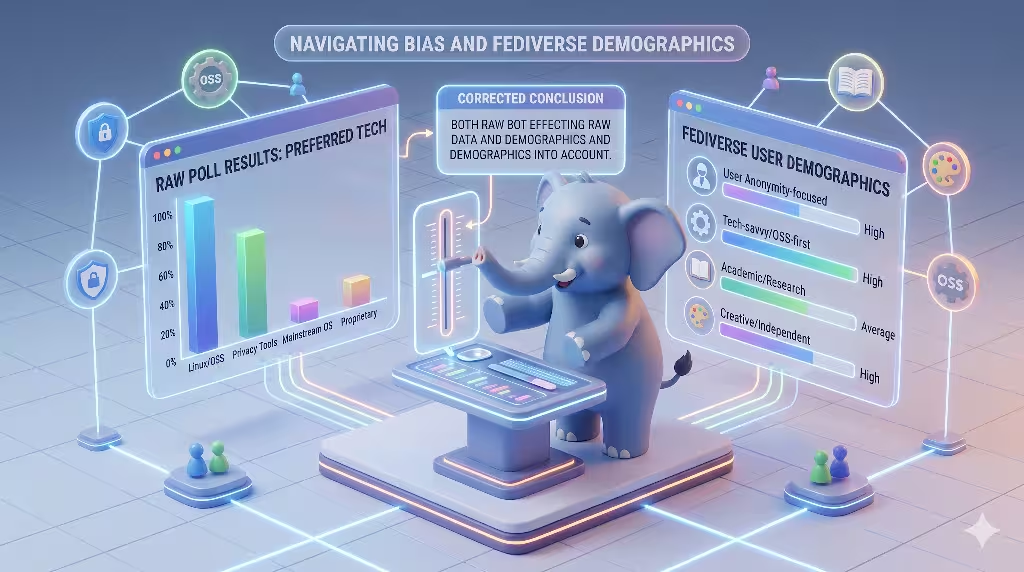
When you look at the results of your mastodon polls, you must understand who is answering your questions. Every social media network has its own unique mix of users. The Fediverse attracts a specific type of person. In general, the users here care deeply about digital privacy. They often dislike large tech monopolies. Many of them work in technology fields, software engineering, academic research, or creative writing. They tend to favor open-source tools over closed, proprietary software.
This demographic mix means your data will have a natural bias. If you ask a general question about technology, the answers you get here will look different from the answers you would get on a platform like Instagram or LinkedIn. For example, if you run a vote asking people what web browser they prefer, a standard internet survey might show that Google Chrome wins by a huge margin. However, on Mastodon, open-source options like Firefox will often win the top spot.
Let us look at a real-world scenario to see how this bias plays out. Imagine a company wants to build a new artificial intelligence tool for a web browser. They run mastodon polls to see how excited users are about this feature. The final numbers show that eighty percent of the voters hate the idea of built-in artificial intelligence. If the company only looks at this data, they might think the whole world hates their idea. But if they analyze the audience, they will realize that Mastodon users are uniquely protective of data privacy and often worry about how artificial intelligence models are trained. The data is still highly valuable, but it represents a specific market segment.
To use this data correctly, you must run a process called data calibration. This means you adjust your final business conclusions based on the known traits of your audience. If your main product targets mainstream corporate offices, you must remember that the feedback you get from mastodon polls reflects a highly tech-literate, privacy-first user base. This feedback is incredibly useful if you want to know what early adopters and security experts think. It is less useful if you are trying to measure the habits of average consumers who do not know what a cookie is. Use this network as a specialized focus group for high-quality, deeply considered tech opinions.
Ethical Analysis and Cookieless Analytics
One of the greatest advantages of using mastodon polls is that the system respects human rights and privacy laws. When a user clicks an option on your survey, their vote is entirely anonymous. The software records the total count of the votes, but it does not save a list of usernames next to the choices they picked. As a researcher, you can see that fifty people chose Option A, but you will never know exactly who those fifty people are.
This total anonymity makes your research completely compliant with modern privacy laws like the General Data Protection Regulation in Europe and the California Consumer Privacy Act in the United States. You do not need to show a annoying cookie banner before people vote. You do not need to ask for an email address or track an internet protocol address. The entire transaction is clean, ethical, and safe. Because users know their data is safe, they are often much more honest when they answer your questions.
To track your research results over time, you can use several privacy-friendly analytics methods. You can log into your server web interface to see the live updates as the numbers grow. If you manage multiple corporate accounts, you can use social media dashboards like Buffer to monitor your active mastodon polls from a single screen. These tools use the platform open application programming interface to pull the total numbers into a clean chart without collecting personal data from the voters.
If we look under the hood at the technical code, the entire system relies on an open internet protocol called ActivityPub. When you create a survey, the server publishes a specific data object known as a Question type. This object contains text strings for your choices and a variable called votersCount. When a person on a completely different server votes on your post, their home server sends a secure message back to your server. This message updates the total tally. The network architecture ensures that the numbers stay accurate and untampered with across thousands of separate servers, keeping your market research data pristine and reliable.
Frequently Asked Questions About Mastodon Polls
How do you get more responses on Mastodon polls?
To increase the response rate on your surveys, you must rely on organic amplification. Because there are no commercial algorithms to boost your reach, you must ask your followers to use the boost button. A boost acts as a share that pushes your post into the timelines of other users. You should also include three or four targeted hashtags at the bottom of your post so people searching for specific topics can discover your questions. Finally, set your duration to seven days and pin the post to the top of your profile so it remains visible to every new visitor throughout the week.
Can you see who voted on a Mastodon poll?
No, you cannot see individual voting records. The software is designed from the ground up to protect user privacy. When someone participates in your market research, the system only increments the total counter for that specific option. It does not display usernames, email addresses, or server locations of the voters. This strict anonymity is a major benefit for researchers because it encourages honest, unbiased answers from participants who know their privacy is fully respected.
Why does editing a Mastodon poll reset the votes?
The platform resets the vote count to zero if you edit the choices or the style of a live survey to prevent fraud and manipulation. If a user votes for an option because they agree with it, an account holder could theoretically change the text afterward to make it look like the user voted for something offensive or completely different. To maintain data integrity and protect users, the ActivityPub protocol wipes existing votes if the core structure of the survey is altered. You can usually edit the descriptive text above the vote without losing your numbers, but you should never touch the choices once voting begins.
What is the maximum duration for a Mastodon poll?
The standard maximum duration for a built-in survey is seven days. When you create the post, you can choose from several preset time limits, including five minutes, thirty minutes, one hour, six hours, one day, three days, or seven days. For comprehensive market research projects, you should always select the seven-day option. This extended window ensures that users across different global time zones and weekend schedules have an equal opportunity to see your post in their chronological feeds.
Advanced Data Analysis for Fediverse Surveys
Once your survey closes and the time limit expires, the real work begins. You now have a set of clean percentages and total vote counts. To turn these raw numbers into a business strategy, you must look deeper than just the winning option. You need to analyze the ratio between your total views, your boosts, and your actual votes. This ratio tells you how deeply your audience cares about the topic you introduced.
If your post received a large number of boosts but a relatively low number of votes, it means the topic is highly interesting to the community, but your specific options might not have matched their experiences. This is a sign that you should run a follow-up project with different choices. On the other hand, if you get a massive number of votes with very few boosts, it means your question was highly engaging to your immediate followers, but it did not have enough general appeal to make people want to share it with the wider network.
High Boosts + Low Votes = High interest, but the choices missed the mark.
Low Boosts + High Votes = High niche engagement among your existing followers.
High Boosts + High Votes = A major market trend that demands immediate business action.
You should also read the written replies to your survey posts very carefully. Because Mastodon users are highly articulate and community-focused, they will often leave long, detailed comments explaining exactly why they chose a specific option. These comments are a goldmine for market research. They give you qualitative data, which means they explain the feelings and reasons behind the raw numbers. A single comment explaining a customer’s frustration with a piece of software can give you more insight than a thousand anonymous clicks.
Integrating Survey Data with Your Product Roadmap
The ultimate goal of gathering information through mastodon polls is to improve your business offerings. When you discover a clear preference or an obvious pain point, you must bring that data directly to your development team. If sixty percent of your users vote that your website menu is confusing, that feedback should immediately become a high-priority ticket in your web design workflow.
Using this data allows you to build products in public. This is a popular business strategy where you share your development journey openly with your customer base. By showing your followers that you changed a product feature specifically because they voted for it in a survey, you build immense brand loyalty. The community sees that you are not a distant, uncaring corporation. They see that you are a responsive, helpful partner who listens to feedback and respects user input.
This open loop of communication creates a sustainable ecosystem for your brand. Your customers feel a sense of ownership in your project because their voices helped shape the final design. In the long run, this community-driven approach is far more valuable than old-fashioned advertising. It creates a loyal army of brand advocates who will gladly boost your posts, recommend your tools, and support your business because you treat them with respect, honesty, and transparency.
Best Practices for Brand Accounts on the Fediverse
To maintain a successful research presence on this network, you must follow a few simple guidelines. First, do not spam your audience with endless questions. If every single post on your profile is a survey, users will get tired of clicking buttons and will unfollow your account. Mix your research posts with high-quality educational content, interesting links, and helpful conversations. A good rule of thumb is to post four or five standard updates for every single market survey you publish.
Second, always share the final results and your conclusions with your audience. When a survey closes, write a follow-up post thanking everyone who participated. Break down what the numbers mean and explain what your company plans to do next based on those results. This builds trust and ensures that people will be excited to participate the next time you ask for their help.
| Strategy Component | Best Practice Action | Expected Outcome |
| Frequency | Limit surveys to 20% of your total post volume | Prevents follower fatigue |
| Transparency | Post a summary of the final numbers and next steps | Builds long-term community trust |
| Engagement | Respond to written comments and text replies | Gathers deep qualitative research |
| Formatting | Use simple language and clear, concise options | Increases total vote volume |
By adopting these healthy habits, your business can unlock the full potential of privacy-first market research. You will save money on expensive analytics tools, protect your customers’ digital rights, and gather the clean, high-signal data you need to build incredible products in a modern, cookieless world. The Fediverse is waiting to tell you exactly what it needs. All you have to do is log in, click the graph icon, and ask.
Structuring the Ideal Market Research Campaign
To get the most value out of your research, you should not look at your posts as isolated events. Instead, you should organize them into a structured campaign. A campaign is a series of connected updates that guide your audience through a complete decision-making process. This method allows you to dig deeper into consumer habits than a single question ever could.
For example, imagine you want to launch a new digital asset for kitchen designers in the Appalachian region. You should start your campaign with a broad question to identify the main interest area. Your first post might ask users what material they prefer for custom countertops. Once that vote concludes and you see a clear winner, you can launch a second, more specific question a few days later. If local soapstone wins the first vote, your second question could ask what finish texture designers prefer for that specific stone.
This step-by-step approach mimics a traditional marketing funnel, but it happens completely out in the open. Each vote builds on the data from the previous week. By the end of the month, you have a complete blueprint for your new product. You know the material, the style, and the exact features your target market wants. Best of all, your audience has been following along the whole time, creating natural anticipation for your official product launch.
Pitfalls to Avoid in Fediverse Market Research
While the native toolset is incredibly powerful, there are several common traps that can ruin your data quality. The first trap is writing leading questions. A leading question is worded in a way that pushes the reader toward a specific answer. For instance, if you ask, “Why do you think our fast new app is better than the slow competition?” you are biasing the results from the start. Your questions must remain completely neutral and objective so users feel safe giving their honest opinions, even if they dislike your product.
The second trap is offering overlapping choices in your options block. Because you are limited to fifty characters per line, you must make sure each option is completely distinct from the others. If you ask about weekly internet usage and your options are “1 to 5 hours” and “5 to 10 hours,” a person who uses the internet for exactly five hours will not know which button to click. Your categories must be mutually exclusive, such as “1 to 4 hours” and “5 to 10 hours,” to keep your final statistics mathematically accurate.
Bad Options (Overlapping):
Option A: 1-5 Hours
Option B: 5-10 Hours

Good Options (Mutually Exclusive):
Option A: 1-4 Hours
Option B: 5-10 Hours
Finally, do not make the mistake of ignoring users who challenge your premise in the comments. On decentralized networks, users are highly independent thinkers. If they feel your survey leaves out an important perspective, they will tell you directly in the replies. Instead of deleting these comments or getting defensive, embrace them as a valuable form of feedback. Often, the comments that correct your initial assumptions contain the most important market insights of your entire campaign.
Comparing Fediverse Tools with Centralized Platforms
To truly appreciate the value of gathering data through decentralized networks, it helps to compare the experience with old, centralized channels. On legacy social networks, your business account is at the mercy of sudden platform changes. A company can change its algorithm overnight, reducing your organic reach to zero unless you pay for sponsored advertisements. This makes long-term trend tracking incredibly expensive and unpredictable.
Furthermore, centralized platforms often pack their user feeds with noise, bots, and corporate ads. This environment lowers the trust level of the average user. When people feel like they are being mined for data by a massive corporation, they are less likely to participate in surveys in a meaningful way. They may click random buttons just to clear their screens, which fills your database with useless, low-quality noise.
Centralized Networks: High noise, bot interference, algorithmic control, paid reach.
Decentralized Networks: High signal, human verification, chronological order, organic reach.
In contrast, the clean environment of independent servers ensures a much higher data signal. Because the network culture resists automated bot manipulation and corporate spam, the votes you receive come from real human beings who are actively reading your text. This high-integrity environment means a sample size of five hundred responses on a decentralized profile can often provide more accurate market guidance than five thousand responses on a noisy, ad-driven platform.
Final Thoughts on Creative Business Research
The digital landscape will continue to shift toward greater privacy, stronger encryption, and user data ownership. Brands that refuse to adapt to this reality will find themselves locked out of consumer insights as tracking cookies disappear entirely from modern web browsers. Embracing decentralized communication tools early gives your company a massive competitive advantage.
By learning to construct clear, engaging, and respectful questions, you transform social media from a megaphone for advertisements into a collaborative workspace. You build a real relationship with a highly intelligent, tech-literate audience that is eager to help you succeed if you treat them fairly. Use the insights from this guide to launch your own research campaigns, refine your product roadmaps, and experience the incredible power of honest feedback through the modern open web.