To understand how a business becomes a part of our lives, we must first understand how we navigate the world. Our brains are not built like digital maps. Instead, we rely on a biological system that seeks out specific points of interest to tell us where we are and where we are going. These points are often community landmarks that stand out in our daily environment. Whether it is a clock tower in the center of town or a giant oak tree in a local park, these markers act as anchors for our memory.
At Silphium Design, we look at how these physical anchors influence the digital world. The role of community landmarks in brand perception is all about building trust. When a brand connects itself to community landmarks, it stops being just a name on a screen. It becomes a part of the user’s mental map. This is a biological need. Humans have always used the landscape to survive. Today, we use that same instinct to choose which businesses we trust.
This article will show you how to use community landmarks to make your brand feel permanent, safe, and easy to find.
Table of Contents
The Lynchian Framework: Imageability and Brand Identity
To understand the Lynchian framework, we must look at the work of Kevin Lynch, who was an urban planner. In his famous book, The Image of the City, he studied how people form mental maps of their surroundings. He realized that our brains do not just see a flat image. Instead, we organize our world into five specific parts. This organization is what he called imageability. It is the quality of a physical object or a place that gives it a high probability of making a strong impression on any observer. When we apply this to branding, we are trying to make a business as memorable as the most famous community landmarks in a city.
The Five Elements of the Lynchian Framework
Paths
The first element is paths. These are the channels along which people move. They can be streets, walkways, transit lines, canals, or railroads. For many people, these are the lead elements in their mental maps. People observe the city while moving through it, and along these paths, the other environmental elements are arranged and related. In the digital world, paths are the navigation menus and the flow of information on a website. If your brand is linked to community landmarks, the path to finding you becomes much clearer in the mind of the customer. They do not just see a link; they see a way toward something familiar.
Edges
The second element is edges. Edges are the linear elements not used or considered as paths by the observer. They are the boundaries between two phases or linear breaks in continuity. Think of shores, railroad cuts, edge of development, or walls. They act as lateral references. For a brand, edges represent the limits of what you do. They define your niche. When a brand sits near community landmarks that act as edges, like a river or a mountain range, it gains a sense of scale. It feels as if the brand is part of the very structure of the region.
Districts
Districts are the third element. Districts are the medium to large sections of the city. A person feels they are entering “inside of” a district because it has some common, identifying character. These are always identifiable from the inside and can also be used for exterior reference if they are visible from the outside. In marketing, a district is like your market category. If your business is located in a historic district filled with community landmarks, your brand perception is automatically elevated. You are seen as a guardian of the local culture because you operate within that specific zone of community landmarks.
Nodes
The fourth element is nodes. Nodes are points or strategic spots in a city into which an observer can enter. They are typically junctions of paths or concentrations of some characteristic. They can be primary junctions, places of a break in transportation, a crossing or convergence of paths, or simply concentrations like a street corner hangout or an enclosed square. In web design, nodes are the call to action buttons or the contact pages. These are the spots where the user stops and makes a decision. By placing these digital nodes near images or mentions of community landmarks, you make the decision feel more natural and grounded in reality.
Community Landmarks
The fifth and most vital element for our discussion is community landmarks. These are another type of point reference, but in this case, the observer does not enter within them. They are usually a rather simply defined physical object: a building, sign, store, or mountain. Some community landmarks are distant ones, like a high tower or a large hill, which can be seen from many angles and distances. Others are local community landmarks, visible only in restricted localities and from certain directions. These include signs, store fronts, trees, doorknobs, and other urban details. They are frequently used clues of identity and even of structure, and seem to be increasingly relied upon as a journey becomes more and more familiar.
Imageability and the Brand Identity
Imageability is what makes a place or a brand stick in your mind. A city with high imageability is easy to navigate and feels inviting. A brand with high imageability does the same thing. By using community landmarks as anchors, a brand can create a mental image that is nearly impossible to forget. This is why we focus so much on the role of community landmarks in brand perception.
When a brand aligns itself with community landmarks, it is engaging in a form of spatial storytelling. It tells the customer that the brand exists in a real place with a real history. This is very important for websites. Since the internet can feel very disconnected and “nowhere,” using community landmarks helps to ground the website. It gives the user a sense of “somewhere.” This feeling of “somewhere” is what builds long term loyalty.
The Biophilic Connection to Lynch’s Elements
From a biophilic perspective, Lynch’s elements match how humans have always moved through nature. Our ancestors looked for paths (animal trails), edges (the forest line), districts (the valley), nodes (the watering hole), and community landmarks (the uniquely shaped rock or the tallest tree). Because our brains are wired this way, we find comfort in designs that follow these rules.
When we use community landmarks in a website, we are satisfying an ancient biological need for orientation. We feel less stress when we know where we are. If a brand helps us feel oriented by using community landmarks, we associate that brand with a feeling of relief and clarity. This is the heart of biophilic design in the digital age. It is not just about putting pictures of plants on a page. it is about structuring information in a way that feels as natural as walking through a city or a forest.
By emphasizing community landmarks, we create a focal point. Just as a lighthouse guides a ship, community landmarks guide a consumer through the sea of digital noise. This makes the brand perception one of strength and reliability. The brand becomes a landmark in its own right, a stable point that the community can rely on.
Does this deeper dive into the Lynchian framework help clarify how we use urban planning to build better digital brands?
The Halo Effect: Borrowed Authority and Brand Equity
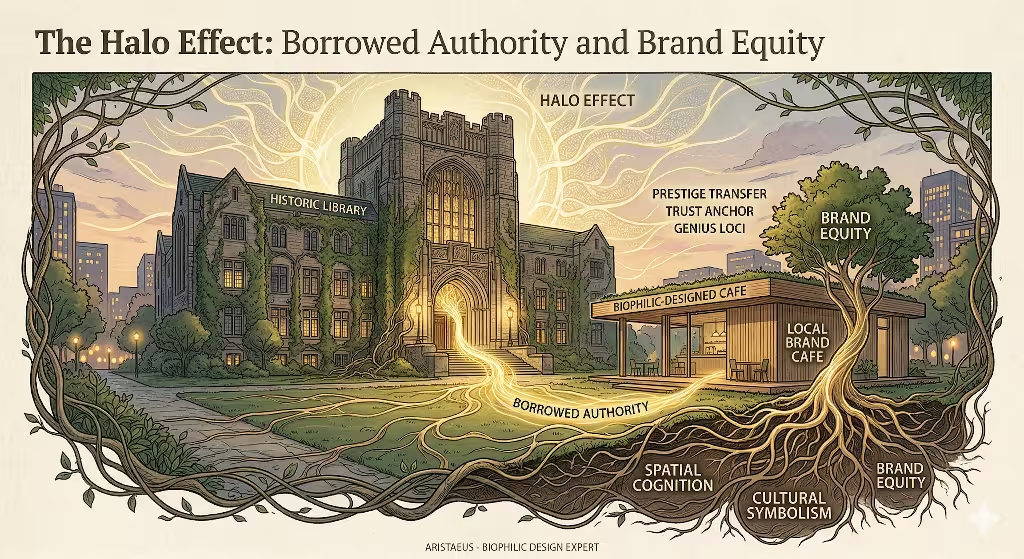
The halo effect is a psychological trick our brains play on us. When we see something we like or trust, we tend to think that everything near it is also good. This is why community landmarks are so powerful for branding. If your business is associated with beloved community landmarks, your business gets some of that love for free. We call this borrowed authority.
Imagine a small bookstore that is right next to a historic library. Because the library is one of the most respected community landmarks in the city, people will naturally trust the bookstore more. They think that if the library is there, the bookstore must be special too. This builds brand equity. Equity is just a fancy word for the value of your brand name. Using community landmarks to build this value is a smart and natural way to grow.
This also leads to cognitive ease. Our brains like things that are easy to think about. If a brand is hard to find or hard to understand, we get tired and look away. But if a brand is linked to famous community landmarks, it is easy to remember. You do not have to work hard to picture where the brand fits in your life. It feels familiar even if it is new.
Cultural symbolism also plays a big part here. Every town has community landmarks that mean something to the people who live there. It might be a bridge where people take wedding photos or a park where everyone goes for fireworks. When a brand celebrates these community landmarks, it shows that it cares about the same things the people care about. This creates a deep bond that traditional ads cannot match.
Biophilic Integration: Natural vs. Built Landmarks
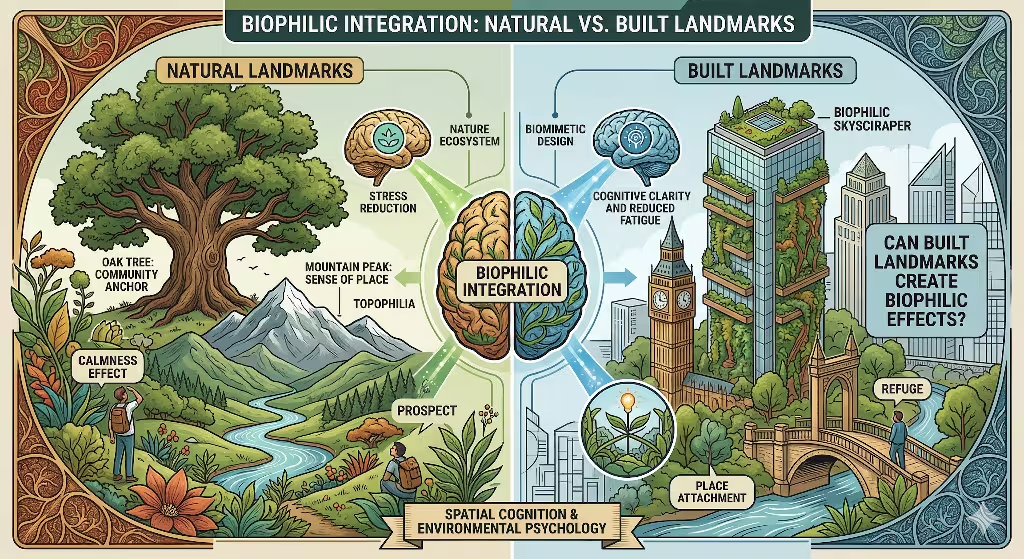
As a biologist, I look at how nature acts as a landmark. Not all community landmarks are made of brick and stone. Some of the most powerful community landmarks are trees, hills, or rivers. These are natural landmarks. Humans have a deep connection to nature, which we call biophilia. We feel more relaxed and happy when we see plants and natural light.
When a brand uses natural community landmarks in its design, it taps into this happy feeling. A website that uses colors from a local forest or images of a local mountain range is using biophilic design. It helps the user feel at home. It makes the digital space feel like a real place.
We can also use biomimetic branding. This means we copy the patterns found in nature. Nature uses landmarks to help animals find food and water. We can use those same patterns to help customers find information. By creating digital community landmarks on a website, like a very clear “contact” button that looks like a natural stone, we guide the user without making them feel stressed.
There is also the idea of refuge and prospect. Humans like to have a safe place to hide (refuge) while still being able to see what is coming (prospect). Community landmarks often provide this feeling. A tall building gives you a great view. A small park with big trees gives you a place to hide. Brands that link themselves to these types of community landmarks feel like they are offering both safety and opportunity to the customer.
Digital Wayfinding: Translating Physical Presence to SEO
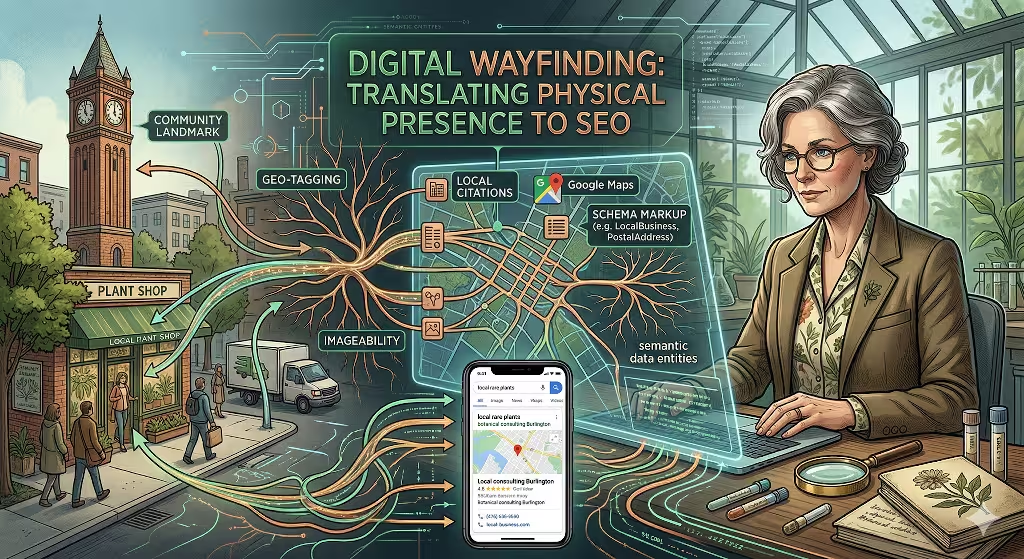
Search Engine Optimization, or SEO, is how people find you on the internet. It is like a digital map. Just like in the real world, the internet uses community landmarks to decide what is important. When you search for something “near me,” Google looks for community landmarks to understand where you are.
Geospatial relevance is a big word for a simple idea. It just means that your brand is relevant to a specific place. If your website mentions local community landmarks, Google understands that you are a part of that community. This helps you show up when people in your town are looking for help. You should use the names of community landmarks in your text and in your photo descriptions.
Schema markup is a type of code that tells search engines exactly what your data means. You can use this code to tell Google that your office is located two blocks away from certain community landmarks. This makes your business show up more clearly on maps. It is like putting a big neon sign on your digital storefront.
The digital landmark is the final piece. Your website should be so easy to use and so beautiful that it becomes a landmark on its own. People should want to come back to it just to see the design. By using biophilic principles and mentioning real world community landmarks, your site becomes a destination. It is no longer just a page; it is a place.
How do landmarks affect brand perception?
You may ask, how these things change what they think about a company. The answer is simple. Community landmarks act as a stamp of approval. When we see a brand next to community landmarks, we feel like the brand has been there a long time. It feels stable. In a world where many online stores disappear overnight, being linked to permanent community landmarks makes you look like you are here to stay. It changes the perception from “just another seller” to “a pillar of the community.”
What is the importance of local landmarks in marketing?
In marketing, we want to stand out. It is hard to stand out when everyone is using the same colors and the same words. However, no two towns have the same community landmarks. By using the specific community landmarks of your area, you make your marketing unique. You are the only brand that can talk about that specific bridge or that specific park in that specific way. This makes your marketing feel personal and real.
How can a business use local landmarks for SEO?
To use community landmarks for SEO, you need to be specific. Do not just say you are in a city. Mention the community landmarks that are near your office. Write blog posts about the history of the community landmarks in your neighborhood. Take pictures of your team at these community landmarks and post them on your site. Use the names of the community landmarks in your “tags” and “meta descriptions.” This tells the search engine that you are a local expert.
What are the 5 elements of city image?
As mentioned before, the five elements are paths, edges, districts, nodes, and community landmarks. Each one helps people build a map in their head. Brands can use these by thinking about their website like a city. The paths are the menus. The edges are the borders of the page. The districts are the different sections like “blog” or “shop.” The nodes are the buttons where people take action. And the community landmarks are the most important images or pieces of information that people remember.
Case Studies: Successful Landmark Brand Integrations
Let us look at how some brands do this well. The “I Love New York” campaign is a great example. It uses the skyline and famous community landmarks like the Statue of Liberty to sell a feeling. When you see those community landmarks, you immediately think of the brand of New York. It is one of the most successful uses of community landmarks in history.
Small businesses can do this too. Think of a coffee shop in Boston that uses a drawing of the Old North Church on its cups. That church is one of the most famous community landmarks in the country. By putting it on the cup, the coffee shop is saying it is a part of Boston’s history. It makes the coffee taste like it belongs to the city.
Another example is a web design firm that uses the colors of the Green Mountains in Vermont. By using the natural community landmarks of the state, they show they are creative and grounded in nature. This attracts customers who value those same things. They are not just selling code; they are selling a connection to the community landmarks they love.
Semantic Entity and LSI Reference Table
| Category | Connection to Landmarks | Why it Matters |
| Cognitive Science | How we remember community landmarks | Helps make your brand stick in the user’s mind. |
| Urban Planning | How we build community landmarks | Helps you design a website that feels like a real space. |
| Local SEO | How we find community landmarks | Helps your business show up in local searches. |
| Biophilia | How we feel about natural community landmarks | Makes your customers feel calm and happy when they see your brand. |
The Future of Biophilic Place Branding
The world is becoming more and more digital, but our brains are still the same as they were thousands of years ago. We still need community landmarks to feel safe and oriented. As we design websites and brands for the future, we must not forget the physical world. The role of community landmarks in brand perception will only get stronger as the internet gets more crowded.
By using community landmarks, you give your brand a soul. You give it a place to stand. You make it easy for people to find you, trust you, and remember you. Whether you are using a famous statue or a beautiful local park, these community landmarks are the key to a successful brand. At Silphium Design, we believe that the best designs are the ones that grow from the earth up. We hope this guide helps you see how community landmarks can change the way people see your business.
Remember that people do not just buy products. They buy a sense of belonging. They want to be a part of something that feels real. Community landmarks are the most real things we have in our cities and towns. When you link your brand to these community landmarks, you are telling your customers that you are a real part of their world. This is the secret to building a brand that lasts for a very long time.
In the end, the goal of using community landmarks is to create a sense of place. Even in the digital world, we want to feel like we are somewhere. By focusing on community landmarks, you turn a simple website into a digital home. You turn a logo into a signpost. You turn a stranger into a neighbor. Use your local community landmarks wisely, and your brand will become a landmark of its own.