
From Static Grids to the Spatial Web
The way we use the internet is changing very fast. For a long time, looking at a website was like looking at a flat piece of paper. You could read words and look at pictures, but you could not touch or feel anything. Today, we are moving into what we call the Spatial Web. This is a big change in how we think about AR Implementation in our daily lives. Instead of just seeing a screen, we are starting to see digital things show up in our real rooms.
At Silphium Design LLC, we think a lot about how nature and technology work together. We call this biophilic design. It means we want our digital world to feel as real and healthy as a walk in the woods. When we talk about AR Implementation, we are talking about a way to bring these two worlds together. It helps us feel more connected to what we are buying or learning because those things appear right in front of us.
In this article, we will look at how AR Implementation is being used by big companies to make more money and keep customers happy. We will also talk about why doing this through a web browser is better than making people download a big app. This is the start of a new way to design for people. It is a way that respects our physical space while giving us all the tools of the internet.
Table of Contents
Defining the Technical Landscape: WebAR vs. App-Based AR
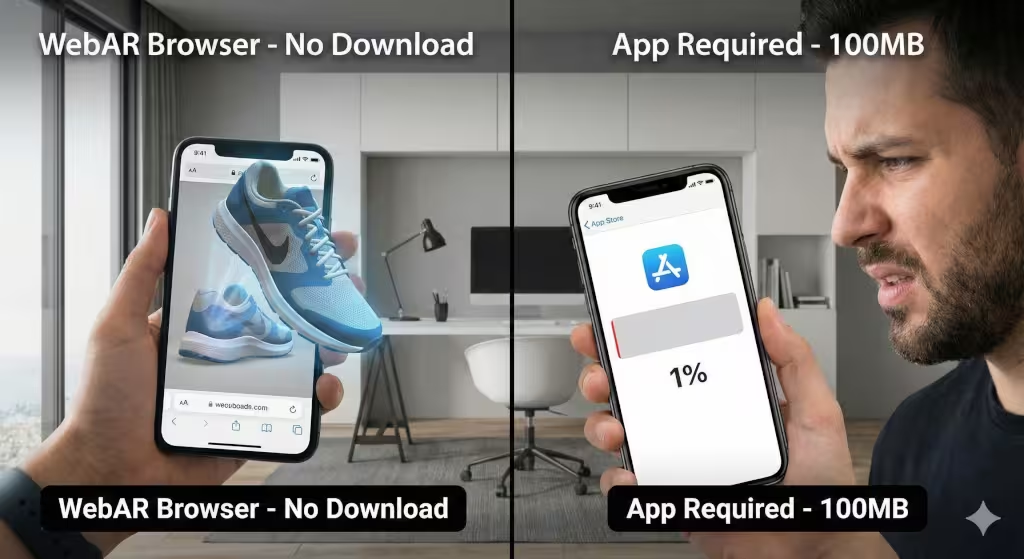
When a company thinks about AR Implementation, they have two main choices. They can build an app that people have to download, or they can put the AR right on their website. We call the website version WebAR. For most people, WebAR is much better. Think about the last time you wanted to try something out. Did you want to wait five minutes for a big app to download? Probably not. WebAR makes AR Implementation happen instantly.
From a technical side, WebAR uses things like HTML5 and WebGL. These are just fancy ways of saying the website can talk to your phone’s camera and brain very quickly. This allows for a smooth AR Implementation without making the user do extra work. When a person can just click a link and see a 3D couch in their living room, they are much more likely to use it. This is why we focus on browser-based tools. It removes the walls between the user and the experience.
Case Study I: E-commerce & Spatial Visualization (The IKEA Effect)
One of the biggest problems with shopping online is that you do not know if something will fit in your house. You might see a beautiful blue chair, but will it be too big for your corner? This is where AR Implementation saves the day. Companies like IKEA were early leaders in this. They used AR Implementation to let people “place” furniture in their actual homes using their phone cameras.
This solved a huge problem called scale uncertainty. When people can see exactly how big a chair is, they feel much more confident. The results were amazing. This type of AR Implementation led to many fewer returns. People didn’t have to send things back because they already knew they fit. This saves the company money and makes the customer happy. This is a perfect example of how AR Implementation improves the user experience by giving people more information.
Case Study II: High-Fidelity Fashion & Beauty (Makeup by Mario)
Fashion and beauty brands have also found great success with AR Implementation. Think about trying on lipstick or glasses. In the past, you had to go to a store and use a sample that many other people had touched. With AR Implementation, you can do this from your couch. Brands like Makeup by Mario use special tech to track your face.
This AR Implementation maps out where your lips, eyes, and cheeks are. Then, it places the makeup colors on your face in real-time. It looks so real that it is hard to tell it is digital. This is what we call a virtual try-on. This kind of AR Implementation helps people find the right shade of makeup without any mess. It also keeps people on the website for a much longer time because it is fun to play with different looks.
Case Study III: Art & Interactive Education (Saatchi Art)
Buying art is a very personal thing. It is also very expensive. Most people are afraid to buy a painting online because they don’t know how it will look on their wall. Saatchi Art fixed this with a clever AR Implementation. They created a “View in My Room” feature. This allows a buyer to see a painting at its actual size on their own wall.
This AR Implementation helped Saatchi Art grow their sales by a lot. They found that people who used the AR tool were much more likely to buy something. It also helped them get more leads. A lead is just a person who might want to buy something later. By using AR Implementation, the brand made the digital gallery feel like a real one. It brought the “cold” digital screen to life.
The SEO Implications of AR Implementation
You might wonder what AR has to do with Google searches. The truth is, AR Implementation is great for SEO. SEO stands for Search Engine Optimization. It is how you get your website to show up at the top of Google. One thing Google loves is “dwell time.” This is how long a person stays on your page. When you have a cool AR Implementation, people stay much longer to play with it.
Also, Google now shows 3D models right in the search results. If you do a good job with your AR Implementation, your products might show up as 3D objects that people can rotate before they even click on your site. This makes your link look much more exciting than a regular text link. This is a very smart way to use AR Implementation to get more visitors.
Technical Optimization: The glTF & USDZ Standard
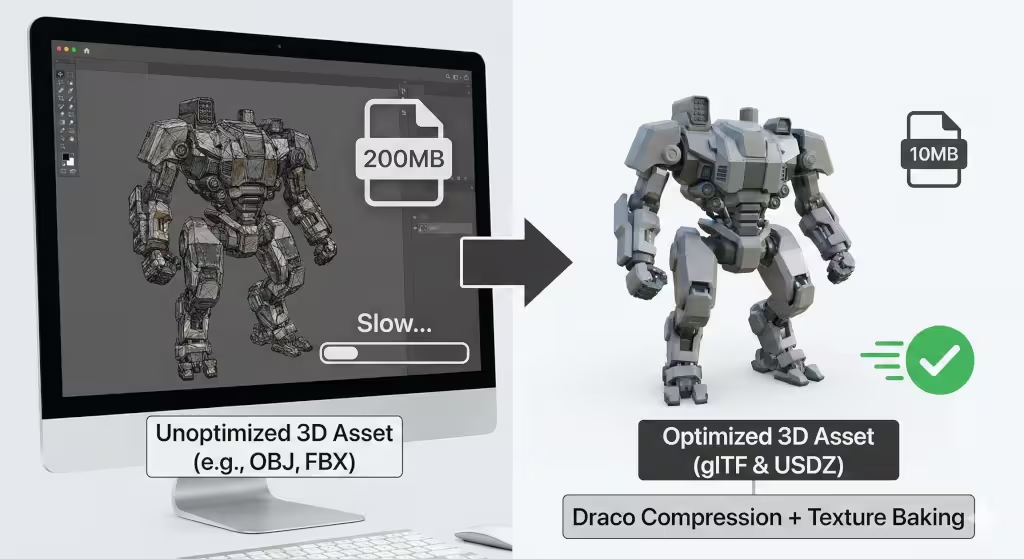
To make AR Implementation work well, the files need to be small. If a 3D model is too big, the website will be slow. Slow websites make people leave. We use special file types like glTF and USDZ for a successful AR Implementation. These files are like the JPEGs of the 3D world. They are small but still look great.
We also use something called Draco compression. This is just a way to squeeze the file down so it loads fast. A good AR Implementation should feel like magic. It should start working the second you tap the screen. If you spend time making your files small, your AR Implementation will be much more successful. This is very important for people who have slower internet or older phones.
UX Best Practices for Immersive Environments
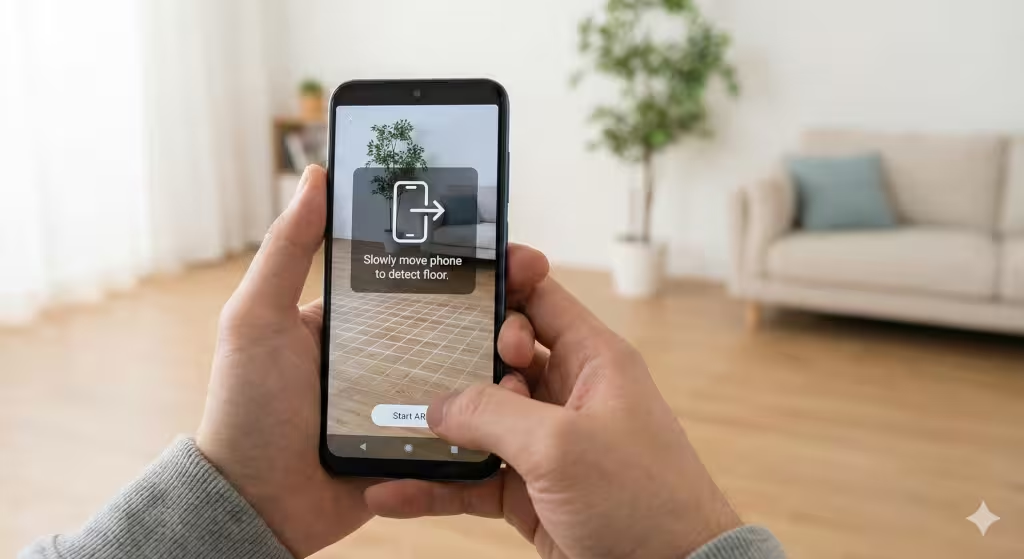
Design is not just about making things look pretty. It is about making them easy to use. When you start an AR Implementation, you have to help the user. Most people are not used to AR yet. You need to give them clear instructions, like “Point your phone at the floor” or “Move your phone around.” This is called onboarding.
A good AR Implementation also needs to be accessible. This means if someone has an old phone that can’t do AR, the website should still work. You should always have a 2D picture as a backup. We want everyone to have a good time, no matter what tech they are using. This is a big part of how we handle AR Implementation at Silphium Design LLC. We want the digital world to be open to everyone.
Questions Answered about AR Implementation
How does AR in web design improve user experience?
AR in web design makes things feel more real. It lets people interact with products. Instead of just looking at a flat picture, they can see a 3D object. This makes the experience more fun and informative. A good AR Implementation gives users the confidence they need to make a choice.
How do AR features impact site performance?
If you are not careful, AR can slow down a site. But if you use the right files, like glTF, it works great. A professional AR Implementation uses compression to keep things fast. This way, the user gets a cool experience without waiting a long time.
What are the differences between AR and VR in web design?
VR, or Virtual Reality, takes you to a whole new world. You usually need a headset. AR, or Augmented Reality, puts digital things into your real world. For most websites, AR Implementation is better because people can use their phones. They don’t need any special gear.
Can AR be used for B2B web design?
Yes, it can! B2B means Business to Business. For example, a company that sells giant machines can use AR Implementation to show a factory owner how a new machine would fit on their floor. It is a great way to show off complex products that are too big to carry around.
Future Trends: B2B AR and Generative AI
The future of AR Implementation is very exciting. We are starting to see AI work with AR. Imagine pointing your phone at a wall, and an AI suggests the perfect paint color and then shows it to you in AR. This is the next step for AR Implementation. It will make our websites even smarter and more helpful.
We are also seeing more “connected” experiences. This means your phone might talk to other things in your room while you use AR. As we get better at AR Implementation, the line between what is real and what is digital will continue to fade. This is not a bad thing. It means we can use technology to enhance our real lives instead of just staring at a screen all day.
The Bio-Digital Future
AR is no longer just a trick for video games. It is a powerful tool for business and design. Through careful AR Implementation, we can create websites that feel alive. We can help people understand products better and feel more connected to the world around them. Whether it is trying on a new watch or seeing how a tree would look in your garden, AR makes it possible.
At Silphium Design LLC, we believe that AR Implementation is a key part of the future of the web. It is a way to bring nature and technology together in a way that helps everyone. As we move forward, the most successful websites will be the ones that embrace this change. They will be the ones that use AR Implementation to make the internet a more human and physical place.
Technical Deep-Dive: Understanding Asset Optimization
To truly master AR Implementation, one must understand the science of 3D assets. When we create a 3D model for the web, we have to think about polygons. Polygons are the tiny triangles that make up a 3D shape. A high-quality AR Implementation needs enough polygons to look smooth, but not so many that the phone gets hot or the site crashes.
We also use something called texture baking. This is a trick where we “paint” the lights and shadows onto the 3D object itself. This makes the AR Implementation look very realistic without requiring the phone to do a lot of hard math. It is these little details that make a professional AR Implementation stand out from a cheap one. By focusing on these technical parts, we ensure that every user has a fast and beautiful experience.
The Role of Haptic Feedback in AR
One new trend in AR Implementation is the use of haptics. Haptics are small vibrations your phone makes. This is a part of Kinesthetic Design. Imagine you are moving a digital chair in AR, and when it “hits” the wall, your phone gives a tiny buzz. This makes the AR Implementation feel much more real. It uses our sense of touch to tell our brain that the digital object is actually there.
This kind of small detail is what separates a good AR Implementation from a great one. It creates a multi-sensory experience. When we use sight, sound, and touch together, the digital world stops feeling like a lie. It starts to feel like a part of our reality. This is the goal of biophilic design: to make technology feel as natural as possible.
Measuring Success: ROI and Metrics
How do we know if an AR Implementation is working? We look at the numbers. We track things like “Engagement Rate.” This tells us how many people actually clicked the AR button. We also look at “Conversion Rate.” This tells us if the AR Implementation actually helped sell the product. In almost every case study, we see that AR makes these numbers go up.
For example, many brands see a 94% increase in conversion when they use AR Implementation. That is a huge number! It proves that people want to interact with things before they buy them. It also shows that the investment in AR Implementation pays for itself very quickly. By reducing returns and increasing sales, AR becomes a vital part of any modern business plan.
The Human Element: Why AR Implementation Matters
At the end of the day, we design for people. As a biologist and a computer scientist, I see AR Implementation as a way to return to our roots. Humans are meant to interact with 3D objects in a 3D world. For the last 30 years, the internet has forced us into a 2D box. AR Implementation is our way out of that box.
It allows us to use our natural instincts. We can walk around an object, look at it from different angles, and see how it fits into our lives. This is the most natural way to use technology. As we continue to improve our AR Implementation methods, we will see a web that is more beautiful, more useful, and more human. It is an honor to be at the forefront of this change at Silphium Design LLC.