
The digital environments we inhabit are often characterized by a functional sterility, a landscape largely detached from the organic connections foundational to human well-being. A growing recognition of this disconnect has spurred a critical re-evaluation of digital design, elevating the principles of biophilia—our innate human affinity for nature—from a niche concept to a central tenet of modern web architecture.
Within this framework, the integration of natural motifs, specifically floral patterns, emerges not as a mere decorative afterthought but as a sophisticated strategic tool. When properly implemented, these patterns can yield significant improvements in a website’s performance, user experience (UX), and the cultivation of a distinct brand identity. The subsequent analysis will examine the underpinnings of this effectiveness, exploring both the profound psychological resonance these forms have on the user and the tangible aesthetic advantages they confer upon a digital interface.
Table of Contents
The Biophilic Connection: Why We’re Drawn to Nature

The foundational principle underpinning the effectiveness of floral patterns is biophilia. Coined by the biologist E.O. Wilson, the biophilia hypothesis posits that humans possess an innate, genetically determined tendency to seek connections with nature and other forms of life. In a pre-digital existence, this connection was constant and unavoidable. Today’s digital interfaces, however, are frequently sterile environments of pure information and function, devoid of organic texture.
By integrating natural analogues like floral patterns, web design taps directly into this deep-seated human need. The visual stimuli provided by these patterns are not merely pleasant; they can trigger positive physiological and psychological responses. Exposure to natural forms has been shown to reduce stress, as measured by cortisol levels, improve cognitive function, and enhance mood. This is not arbitrary; it is a predictable response to re-introducing elements of an environment we evolved to thrive in. A website that leverages this connection is, by extension, creating a more restorative and less taxing user experience.
Tangible Benefits of Integrating Floral Patterns
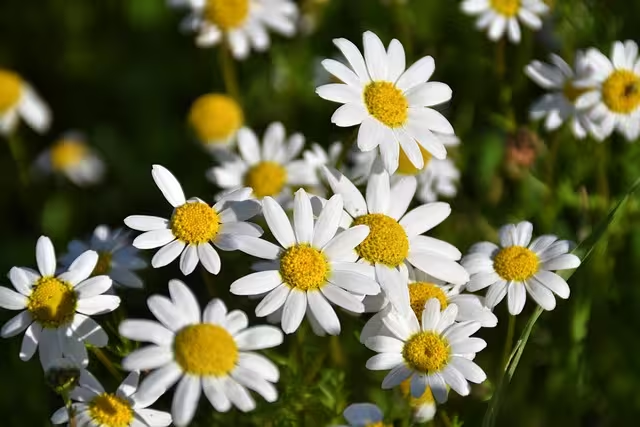
Moving from the theoretical to the practical, the application of floral patterns provides a suite of measurable benefits that directly impact a website’s key performance indicators (KPIs).
Enhanced User Engagement and Reduced Bounce Rates
A primary objective for any website is to retain user attention. Floral patterns, with their inherent complexity and organized structure, are uniquely suited for this task. This phenomenon can be partially explained by the concept of fractal fluency. Fractals are complex, self-repeating patterns found ubiquitously in nature—from snowflakes to ferns to flower petals. Research indicates that the human brain processes these natural fractals with high efficiency and experiences a state of relaxed engagement. A well-chosen floral pattern provides a level of visual complexity that holds interest without inducing the cognitive strain of a chaotic or overly simplistic design. This sustained, effortless engagement translates directly into lower bounce rates and increased time on page.
Improved Brand Perception and Identity
Patterns are a powerful tool in the semiotic arsenal of a brand. Flowers, in particular, are laden with cultural and emotional meaning. The choice of floral is therefore a strategic decision in brand positioning. A design centered around elegant, minimalist orchids can communicate sophistication and luxury. A pattern of bright, bold sunflowers can evoke feelings of optimism, warmth, and accessibility. Vintage botanical illustrations can signal tradition, authenticity, and scientific rigor. By carefully selecting a floral motif that aligns with its core values, a brand can build a powerful, non-verbal rapport with its audience, making its identity more memorable and emotionally resonant.
Increased Conversion Rates
The positive affective state induced by biophilic elements has a direct impact on user behavior, including purchasing decisions. When a user feels calm, positive, and engaged, their receptiveness to a call-to-action (CTA) is significantly heightened. The positive valence associated with the floral aesthetic can transfer onto the products or services being presented, a psychological principle known as affect heuristic. Strategically, floral elements can be used as visual cues to guide the user’s eye toward critical conversion points like “Add to Cart” or “Sign Up” buttons. By framing these actions within a positive visual context, the design subtly reduces decision friction and encourages conversion.
Greater Design Versatility
The term “floral pattern” encompasses a vast aesthetic spectrum, making it one of the most versatile elements in a designer’s toolkit. Its application is not limited to any single industry or brand archetype.
- Minimalist & Line Art: Ideal for tech companies, modern wellness brands, and professional services seeking a touch of organic elegance without visual clutter.
- Abstract & Watercolor: Suited for creative agencies, artisanal e-commerce, and personal portfolios where a unique, artistic feel is desired.
- Photorealistic & Vibrant: Powerful for travel agencies, food blogs, and brands aiming to convey energy, freshness, and vivid experiences.
- Vintage & Botanical: Perfect for heritage brands, organic product lines, and educational sites that wish to project an image of authenticity, tradition, and expertise.
This adaptability ensures that a floral theme can be calibrated to meet nearly any branding requirement.
Common Questions About Floral Web Design

Are floral patterns outdated in web design?
This is a common misconception rooted in the overwrought, low-resolution patterns of the early web. Modern floral design is defined by subtlety and intentionality. The trend has evolved towards sophisticated interpretations: minimalist line drawings, large-scale abstract botanicals used as focal points, and monochromatic textures. When executed with contemporary design principles, florals are not outdated; they are a timeless element rendered in a modern context.
How do I use floral patterns without my website looking too feminine?
The association of florals with femininity is purely cultural and can be easily directed through strategic design choices. To achieve a neutral, masculine, or universally appealing aesthetic, focus on:
- Color Palette: Utilize dark, moody backgrounds, monochromatic schemes, or earthy, neutral tones.
- Pattern Style: Opt for abstract, geometric, or tropical leaf patterns over traditional flower motifs.
- Scale and Placement: Use a large-scale, dramatic floral image as a hero background or a subtle, small-scale pattern as a minor texture.
Can floral patterns be professional?
Absolutely. For corporate or B2B websites, professionalism is conveyed through restraint and sophistication. A subtle, low-contrast floral or botanical pattern used as a background texture on a section of a page or as a watermark element can add a layer of visual interest and quality without distracting from the primary content. This demonstrates attention to detail and an elevated design sensibility, reinforcing a brand’s professionalism.
What are the best practices for using patterns in UI/UX design?
- Serve a Purpose: Patterns should enhance the design, not dominate it. Use them to create visual hierarchy, define sections, or highlight key elements.
- Ensure Readability: The primary function of a website is information transfer. Always verify that text placed over a pattern has a sufficient contrast ratio to be easily legible (WCAG AA requires a contrast ratio of at least 4.5:1 for normal text).
- Optimize for Performance: Large, complex pattern images can drastically increase page load times. Use optimized image formats like
$WEBP$, compress files aggressively, and whenever possible, use lightweight, repeatable patterns implemented via `CSS to minimize file size and HTTP requests. - Maintain Consistency: The use of patterns should be consistent and predictable throughout the user’s journey to create a cohesive and intuitive experience.
Implementation and Best Practices
Technical SEO Considerations
A visually rich site must also be technically sound. Large floral images are a potential performance bottleneck that can negatively impact SEO rankings. To mitigate this, prioritize image optimization. Convert all pattern images to a next-gen format like $WEBP$, which offers superior compression compared to $JPEG$ or $PNG$. This directly improves metrics like Largest Contentful Paint (LCP), a core component of Google’s Core Web Vitals. For repeating patterns, the most efficient method is to use a small, seamless tile and repeat it using a $CSS background-image property, which requires only a single, tiny file download.
Design Principles
The successful integration of floral patterns hinges on foundational design principles. Balance is paramount; a dense pattern must be counter-weighted with ample negative space (white space) to prevent a cluttered and overwhelming interface. This allows the user’s eye to rest and process information. Furthermore, patterns must support, not disrupt, the visual hierarchy. Use them to draw attention toward important content and CTAs, rather than allowing them to compete for the user’s focus.
Conclusion
The integration of floral patterns into web design is an evidence-based strategy, not a stylistic whim. It is a direct application of biophilic principles to create digital environments that are more engaging, psychologically resonant, and effective. By leveraging our innate connection to nature, these patterns offer a clear path to improving user engagement, building a more memorable brand identity, and ultimately, driving conversions. The decision to use floral elements is a commitment to a more human-centric design philosophy—one that recognizes that even in a digital world, our well-being is tied to the natural one. We encourage you to analyze how these organic forms could be strategically implemented within your own digital projects.