Table of Contents
The New Frontier of Brand-Creator Partnerships

The 2026 Landscape
The digital world has changed a lot over the last few years. People are tired of traditional social media sites. They are tired of seeing their personal data sold to the highest bidder. They are tired of algorithmic feeds that show them angry content just to keep them clicking. Because of this, millions of high value users have moved to privacy first, decentralized networks like Mastodon. This shift has changed the rules for how businesses connect with consumers. If you want to build a successful marketing plan today, you have to understand this new space. You cannot just buy your way into a user feed anymore.
When you look at Mastodon, you see an audience that is highly engaged. These users are not just scrolling mindlessly through a feed while watching television. They are actively reading, replying, and sharing content. They have chosen to be on a platform that rejects corporate advertising. This creates a unique challenge for companies. How do you reach people who have intentionally walked away from traditional ads? The answer is simple. You must learn how to build a real brand collaboration with the people those users already trust.
A brand collaboration in this space looks very different from an Instagram ad or a sponsored video on TikTok. In 2026, marketing is all about respect and community. The old methods of blasting generic ads at millions of people do not work here. Mastodon users appreciate authenticity. They want to see businesses talk like real people, not corporations. If your business wants to grow its presence on the Fediverse, finding the right partners is the most important step you can take. A good brand collaboration can open doors to highly loyal customers who will support your company for years.
The Paradox of Discovery
Many marketing managers run into a major wall when they first try to set up a brand collaboration on Mastodon. They open up their usual software tools, like influencer marketing databases or social listening dashboards, and they find absolutely nothing. They search for keywords and get zero results. This happens because traditional influencer tools rely on central databases that constantly scrape web data. Mastodon is built to prevent that exact type of corporate spying. The platform protects user privacy by blocking automated data scrapers.
This creates a true paradox of discovery. The very features that make Mastodon users so valuable, like their high trust and active engagement, also make them hard to find using old school marketing tools. You cannot just download a spreadsheet of the top fifty accounts in your industry. If you want a successful brand collaboration, you have to find your partners manually. You have to learn how the system works from the inside out.
At Silphium Design LLC, we help businesses navigate these exact technical and social challenges. We know that you cannot treat a decentralized network like a centralized corporation. If you try to use automated software to hunt for partners, you will fail. Worse, you might ruin your business reputation before you even get started. Finding users for a brand collaboration requires a shift in your mindset. You must stop thinking like a cold data scientist and start thinking like a community organizer.
The Thesis
The secret to a profitable brand collaboration on Mastodon is simple to state but requires effort to execute. It does not rely on buying raw reach or paying for millions of low quality impressions. Instead, it relies on identifying local community authorities who hold genuine trust within their specific circles. On this platform, a user with five hundred followers can often drive more sales than an account with fifty thousand followers on a traditional site. This happens because those five hundred followers are deeply connected to the creator.
When you invest in a brand collaboration with a trusted Fediverse creator, you are buying into their reputation. If the community sees that a creator respects your company, they will respect your company too. But if a creator posts a lazy, corporate style advertisement, their audience will call them out immediately. Every single brand collaboration must be built on mutual benefit and shared values. Your goal should not be to find a megaphone to shout your message. Your goal must be to find a respected partner who can introduce you to the neighborhood.
This comprehensive guide will show you exactly how to do that. We will break down the technical realities of the platform. We will give you actionable steps to find creators. We will share the exact rules of etiquette you must follow when pitching a brand collaboration. By the time you finish reading, you will have a clear, reliable system for building real relationships that drive actual traffic to your website.
Understanding the Mastodon Ecosystem (The Technical Foundation)
The Role of Instances (Servers)
To find partners for a brand collaboration, you first need to understand how Mastodon is built. Unlike traditional social media platforms, Mastodon is not a single website owned by one large company. It is a collection of thousands of independent websites called instances, or servers. Think of it like a global network of independent towns. Each town has its own rules, its own culture, and its own mayor. However, all these towns are connected by a highway system, allowing citizens to talk to each other across town borders.
When you search for creators to form a brand collaboration, you must look at these specific servers. Some servers are general and open to anyone. Other servers are highly specific, dedicated entirely to topics like technology, graphic design, environment, or literature. For example, if your company sells high quality woodworking tools, you do not want to look for partners on a general server. You want to find creators who live on a server dedicated specifically to makers, craftspeople, or manual engineering.
Knowing which server a user calls home tells you a lot about their values and interests. It helps you understand if they are a good match for a brand collaboration. The server choice acts as a natural filter for your marketing efforts. When you understand the personality of different servers, you can narrow your search down significantly. You can focus your energy only on the digital neighborhoods where your ideal customers hang out every day.
The Three Feeds
Once you create an account for your company, you will notice that Mastodon gives you three completely different ways to view content. These are known as the Home feed, the Local feed, and the Federated feed. Understanding how these timelines work is crucial when planning a brand collaboration. Each feed represents a different layer of communication on the network, and each layer requires a different observation strategy.
+-----------------------------------------------------------------+
|                       MASTODON'S THREE FEEDS                     |
+-----------------------------------------------------------------+
| 1. HOME TIMELINE       | Only shows posts from accounts you     |
|                        | explicitly choose to follow.           |
+------------------------+----------------------------------------+
| 2. LOCAL TIMELINE      | Shows every public post made by users  |
|                        | who live on your specific server.      |
+------------------------+----------------------------------------+
| 3. FEDERATED TIMELINE  | Shows posts from your server plus any  |
|                        | post your neighbors are following.     |
+-----------------------------------------------------------------+
The Home timeline only shows posts from people you explicitly follow. This is your curated view. The Local timeline shows every public post made by users who live on your specific server. This is an amazing place to look for a brand collaboration if your company joins a server that matches your industry. The Federated timeline shows posts from your server plus any post that users on your server are currently following from other servers. By watching the Local and Federated feeds of industry specific servers, you can see which creators are sparking conversations. You can watch who is sharing good ideas and who is getting noticed by the community before you even ask for a brand collaboration.
Protocol Over Platform
The magic technology that connects all these independent servers is an open source system called the ActivityPub protocol. A protocol is simply a shared set of rules that allows different software programs to talk to each other. Because Mastodon runs on this protocol, a user on one server can seamlessly follow, reply to, and share posts from a user on a completely different server. This means your brand collaboration is not limited by server walls.
When you set up a brand collaboration with a creator, their posts can travel across the entire network. A user on a technology server can see a post shared by a creator on an art server, as long as they are connected. This open system means you do not need to make an account on fifty different servers to find people. You just need to find the core nodes in the network.
Understanding this protocol helps you realize that a brand collaboration on Mastodon has a wider reach than it seems at first glance. Your partner is not just talking to the people on their own server. They are talking to anyone across the entire global Fediverse who follows them. This makes the network incredibly powerful for organic marketing, provided you choose your partners wisely.
Core Strategies: How to Find Mastodon Users for Brand Collaboration
Strategic Hashtag Tracking & Social Listening
Because Mastodon does not have a central search engine that reads every word of every post, hashtags are the primary way information is organized. If a user does not include a hashtag in their post, that post cannot be found by someone who does not follow them. This design is intentional, meant to prevent random strangers or bots from jumping into private discussions. For a marketing manager seeking a brand collaboration, this means hashtags are your absolute best friend.
To start your search, open the advanced web interface on Mastodon. This layout allows you to set up multiple columns on your screen, with each column tracking a specific hashtag in real time. If you want to find people for a brand collaboration, you should track terms related to your industry. For example, if your company focuses on eco friendly home design, you could track tags like green building, sustainable design, or biophilic living.
As you watch these columns, do not just look for the people who post the most. Look for the people who write the most helpful replies. Look for the users who start deep threads that get shared by others. When you find someone who consistently provides value under a specific tag, you have found a great candidate for a brand collaboration. You can save their profile link and start watching their content more closely over the next few weeks.
Additionally, pay close attention to the introductions hashtag. New users use this specific tag to write a short biography about themselves when they join the platform. By monitoring this tag, you can catch professional creators, engineers, and writers the moment they arrive on the network. This gives you a unique chance to propose a brand collaboration early, helping them build their presence while they help your business grow theirs.
Leveraging Curated Fediverse Directories
Since you cannot rely on automated software tools to find users, you must take advantage of human curated directories. The Mastodon community relies heavily on lists compiled by real people who want to help others find good accounts. These directories are goldmines for any business searching for a meaningful brand collaboration. They list users who have explicitly stated that they want to be found and are open to networking.
One of the most popular tools is called Trunk. Trunk is a community driven directory where users list their profiles under specific categories like science, technology, art, or writing. You can browse through these lists to find active users who are already recognized as contributors in their fields. Because these users volunteered to be on the list, they are usually much more open to a brand collaboration pitch than a random user.
Another incredible resource is Fedi.directory. This is a fully curated, hand checked catalog of interesting accounts across the network. The person running the directory writes short descriptions of what each account focuses on. This makes it incredibly easy to scan for partners who fit your corporate values. When you use these directories, you are tapping into a list of verified, active human beings. This cuts out all the noise and saves your team dozens of hours of manual search time.
Finally, do not forget to look at the explore pages of individual servers. If you visit a server website without logging in, you can click on their public explore page. This area shows you the most popular posts, trending tags, and highly active users on that specific server over the past week. It gives you a quick snapshot of who holds influence in that specific town, giving you clear targets for your next brand collaboration campaign.
+-----------------------------------------------------------------+
|                  KEY DIRECTORIES TO FIND PARTNERS               |
+-----------------------------------------------------------------+
| DIRECTORY NAME   | WHAT IT OFFERS                               |
+------------------+----------------------------------------------+
| Trunk            | A community list sorted by professional      |
|                  | categories and specific interests.           |
|                  |                                              |
| Fedi.directory   | A hand curated catalog with descriptions of  |
|                  | high quality, active creators.               |
|                  |                                              |
| Server Explore   | Public pages showing top trending posts and  |
|                  | active users on specific servers.            |
+-----------------------------------------------------------------+
Mapping the Social Graph (The Network Effect)
Once you find even one or two respected users in your industry, you can use the power of the social graph to find dozens more. The social graph is just a technical term for the web of connections between people. On Mastodon, public figures usually leave their follower and following lists open for anyone to read. This allows you to explore who the experts trust, which is a great way to scale your brand collaboration search.
Go to the profile of a user you respect and click on their following list. See who they are reading every day. Experts tend to follow other experts. If you notice that three or four top professionals in your space all follow the same graphic designer or engineer, that person is a prime candidate for a brand collaboration. They clearly have earned the respect of their peers, which is the highest form of currency on the Fediverse.
You can also use open source web tools like Followgraph. This tool allows you to input a specific Mastodon handle, and it analyzes the social graph of that user. It looks at everyone that user follows, and then looks at who those people follow. The tool then outputs a list of the most popular accounts within that specific sub community. It provides a visual map of the local authorities. Using this tool gives your business a massive advantage, letting you find the perfect partner for a brand collaboration without relying on corporate databases.
Keep an eye out for people who act as curators or boosters. These are accounts that might not write long posts themselves, but they have an incredible eye for talent. They spend their day re sharing the best work of other people. By looking at who these curators are boosting, you can find hidden gems. You can discover smaller, rising creators who are perfect for a targeted brand collaboration before they get overwhelmed by other corporate offers.
Frequently Asked Questions about Mastodon Brand Collaboration
How do I find people to follow on Mastodon?
Finding people to follow requires a bit more active effort than it does on traditional corporate networks. Because there is no central algorithm feeding you content based on your web browsing history, you have to guide your own journey. The absolute best way to start is by using the search bar to look up specific hashtags that match your personal or business interests. When you find a post that makes you think or teaches you something new, click on that user profile and hit the follow button.
Another great strategy is to look at the local timeline of different servers. If you are interested in software development, take a look at a server dedicated to programmers. Spend a few minutes reading their public feed. You will quickly spot users who consistently post interesting updates and helpful advice. You can also use curated directories like Trunk or Fedi.directory, which group active users together by topic.
Lastly, when you find an account you really enjoy, take a look at their public following list. See who they are learning from. This organic approach creates a high quality feed filled with real human thoughts. It lays the perfect groundwork for future business relationships, making it much easier to plan a successful brand collaboration down the road.
Can you do influencer marketing or commercial promotion on Mastodon?
Yes, you can absolutely engage in commercial promotion and influencer marketing, but the way you execute it must change completely. Mastodon has no built in ad manager system. There are no sponsored posts that you can pay the platform to force into a user feed. The entire software framework is completely ad free. This means all commercial success relies entirely on organic reach, community reputation, and genuine partnerships.
If you want to promote a product, you cannot just drop a banner ad or a corporate script into the ecosystem. You must work with creators to build a brand collaboration that feels like a natural conversation. The promotion needs to focus on solving a problem, explaining a technical detail, or offering real utility to the public.
+-----------------------------------------------------------------+
|                TRADITIONAL VS. MASTODON MARKETING               |
+-----------------------------------------------------------------+
| CENTRALIZED MARKETING  | DECENTRALIZED MARKETING (MASTODON)     |
+------------------------+----------------------------------------+
| Paid ad dashboards     | No paid ads; completely organic        |
| Algorithmic reach      | Reach earned through community boosts  |
| Focus on impressions   | Focus on deep trust and engagement    |
| Corporate script push  | Authentic brand collaboration focus    |
+-----------------------------------------------------------------+
Influencer marketing here is closer to traditional public relations and community sponsorship. It is about building long term allies rather than buying short term clicks. When a business understands this distinction, they can unlock incredible results. A brand collaboration that respects the audience will stand out precisely because the platform is not crowded with noisy corporate advertisements.
Does Mastodon allow brand collaboration and sponsored posts?
The answer to this question depends entirely on the specific rules of the server where the creator lives. Because Mastodon is fully decentralized, there is no single terms of service document that applies to every user. Every independent server is run by an administrator who sets their own rules for moderation and commercial content. Some servers completely ban any form of corporate promotion or sponsored content, while others welcome it as long as it remains honest and transparent.
Before you launch a brand collaboration with a creator, you must check their server rules. You can find these by visiting the main domain of their server and looking at the about page. If the server rules state that commercial content is forbidden, forcing a sponsored post there will get the creator account banned and your company profile blocked.
To ensure a successful brand collaboration, always make sure your partner is allowed to post promotional material on their home instance. If their current server bans it, some creators will even open a separate account on a business friendly server just to handle their commercial work. Transparency is the law of the land. Any sponsored post should clearly state the nature of the partnership, ensuring that the brand collaboration remains ethical, legal, and respectful of the local community standards.
Vetting Mastodon Creators for Authenticity and Alignment
Moving Past Vanity Metrics
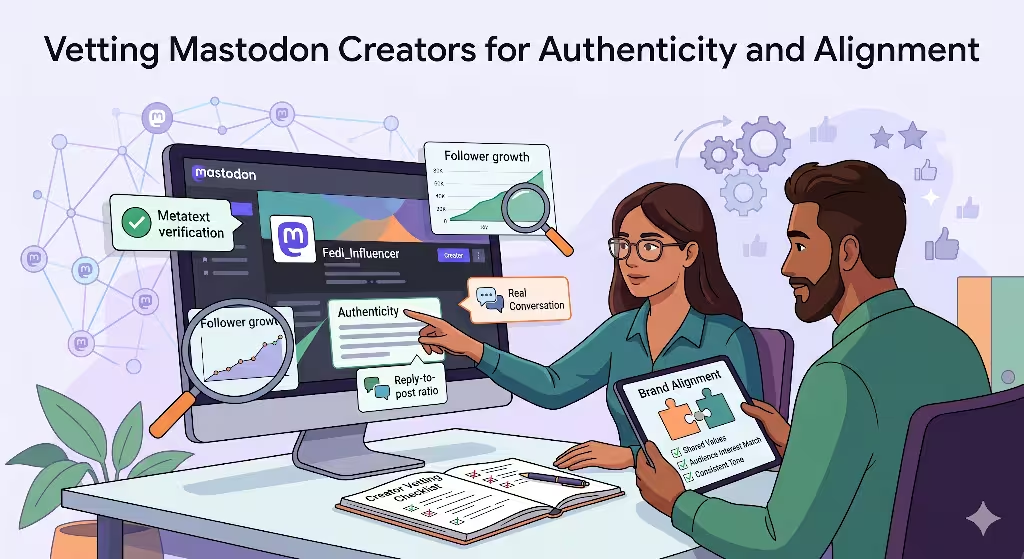
On traditional networks, marketing teams are obsessed with vanity metrics. They look at total follower counts, verified badges, and view counters to determine if a creator is worth a brand collaboration. On Mastodon, you have to throw that old playbook away. Follower counts are often misleading or completely hidden. Because there are no data tracking algorithms boosting popular accounts, massive follower counts are rare. A creator with two thousand followers here is often an incredibly powerful community leader.
When vetting a partner for a brand collaboration, you must look at the quality of the conversations happening on their profile. Read their replies. Are they actually talking to people, or are they just broadcasting links into the void? An account that just automates a feed from their blog without interacting with the community has zero real influence. They will not bring any value to your brand collaboration.
Look for depth of engagement. Check if people are asking the creator questions, and check if the creator takes the time to give thoughtful, helpful answers. A true professional influencer in the Fediverse acts like a helpful neighbor. They use their competence to guide others. If you base your brand collaboration choices on the depth of these interactions rather than the raw number of followers, your marketing campaigns will be far more effective.
The Ultimate KPI: Boosts (Reshares)
If you cannot rely on follower counts, what metric should you track to measure the potential value of a brand collaboration? The absolute most important key performance indicator on Mastodon is the Boost. A Boost is the platform equivalent of a retweet or a share. Because there is no algorithm, the only way a post moves from one server to another is when a user chooses to manually click the Boost button.
When a user boosts a post, they are telling their entire personal network that this content is worth reading. This means that Boosts are the literal engine of reach on the Fediverse. Before signing a brand collaboration deal, look at a creator’s recent history. See how many of their original posts have been boosted by their audience. If their posts get a lot of favorites but zero boosts, their content is hitting a dead end. It is not traveling across server lines.
+-----------------------------------------------------------------+
|                   UNDERSTANDING THE FAVORITE VS BOOST           |
+-----------------------------------------------------------------+
| THE FAVORITE (STAR BUTTON)   | Acts as a private nod of approval|
|                              | to the author. Does not spread   |
|                              | the post to any other feeds.     |
+------------------------------+----------------------------------+
| THE BOOST (LOOPING ARROWS)   | Re-shares the post to everyone   |
|                              | who follows you. This is the     |
|                              | sole driver of organic reach.    |
+-----------------------------------------------------------------+
A partner whose posts regularly get boosted is an amazing asset for a brand collaboration. Their audience acts as an active distribution network. When that creator shares a post about your business, you are not just reaching their direct followers. You are reaching every single person who follows anyone who boosts that post. This network effect can make a targeted brand collaboration go viral across the entire Fediverse very quickly.
Culture & Tone Check
The final step in vetting a creator for a brand collaboration is a thorough review of their culture and tone. The Fediverse has a very specific set of social norms. Users highly value accessibility, privacy, and polite discussion. If a creator is constantly getting into aggressive political arguments, mocking other users, or posting low effort clickbait, they are a terrible match for a corporate brand collaboration. Joining forces with them will cause immediate backlash.
Take a look at how the creator uses accessibility tools. Do they add descriptive alt text to every image they upload? Do they use content warnings when discussing sensitive topics? On Mastodon, these small acts of community care are expected. A creator who skips these details shows that they do not fully respect the platform culture. Working with them on a brand collaboration could make your company look lazy or out of touch.
Make sure the creator does not run a ghost account. A ghost account is a profile that uses automated software to cross post content from Twitter or LinkedIn without ever logging in to reply to users. These accounts are widely disliked on the network. A brand collaboration with a cross posting bot will yield zero clicks and zero conversions. You need a partner who is a living, breathing participant in the Mastodon community.
Outreach Etiquette: Pitching the Fediverse Creator
The Spam Filter Trap
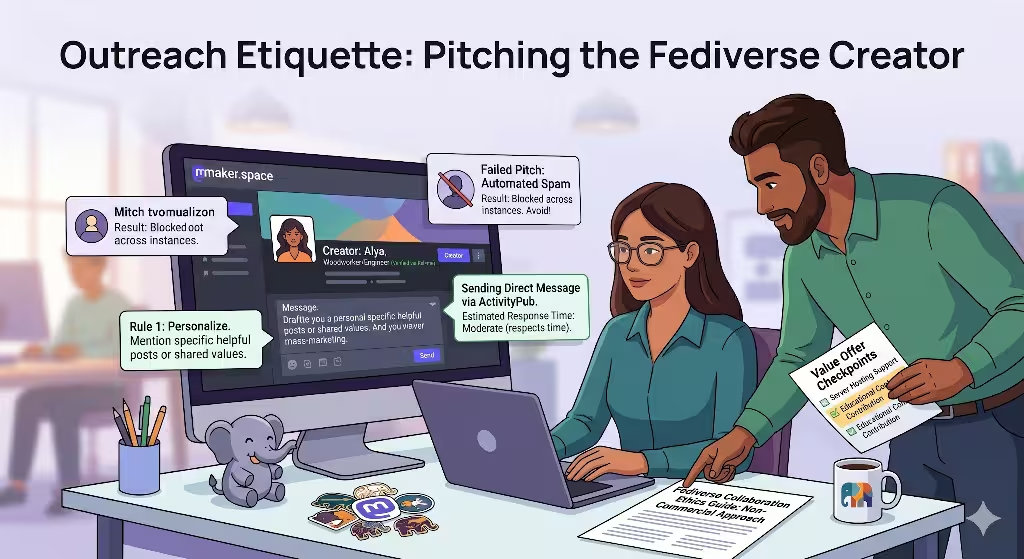
Once you find the perfect creator for your brand collaboration, you have to be incredibly careful with how you make your initial approach. If you send a cold, generic copy and paste marketing message to fifty different users, you will walk right into a massive trap. Mastodon users and server administrators have incredibly low tolerance for corporate spam. The platform tools make it very easy for a user to block your account, report your profile to the admin, and get your entire domain muted across the server.
If your company account gets flagged for spam, your marketing efforts are over before they even started. You cannot just create a new account under a different name, because administrators can block your entire website URL. This means no one on that server will ever be able to see a link to your business page again. This strict moderation is why your approach to a brand collaboration must be careful, personal, and deeply respectful.
Never use automated direct messages to pitch a brand collaboration. Never tag ten different creators in a single public post asking them to look at your product. These tactics are seen as rude and intrusive. To build a lasting relationship, you must treat creators like professional peers. You must take the time to write a unique, thoughtful pitch for every single person you contact.
The Peer-to-Peer Approach
The most effective way to secure a brand collaboration on Mastodon is to use a peer-to-peer approach. This means your business needs to act like an active, helpful member of the community for several weeks before you ever ask for a single thing. Start by setting up a complete, professional profile for your brand. Fill out your biography, upload a clean logo, and link to your verified website.
Next, start interacting with your target brand collaboration partner organically. Read their posts. If they share a great article, click the Boost button to share it with your own followers. If they ask a technical question that your team knows how to answer, leave a helpful, polite reply without trying to sell them anything. Show them that your company understands how to add value to the network.
After you have established a friendly baseline, you can reach out to discuss a brand collaboration. You can send them a direct message on the platform or, better yet, look at their profile metadata to find their professional email address. When you write your message, mention specific posts they have made that you genuinely enjoyed. Explain why you think their personal voice and values align perfectly with your business goals. This personal touch shows that you respect their work, making them much more likely to accept your brand collaboration offer.
The Value Proposition
When you pitch a brand collaboration to a Fediverse creator, your financial offer needs to look a bit different than a traditional sponsorship deal. Many creators on this platform are passionate about open source software, user privacy, and digital freedom. While they certainly appreciate being paid fairly for their work, they also care deeply about how a partnership impacts their community standing.
To make your brand collaboration offer truly enticing, think about how your company can support the creator’s world. Can your business offer to pay for the monthly hosting fees of their home server? Can you donate to the open source software projects they volunteer for? Can you work together to build a high utility, free educational resource for their audience?
+-----------------------------------------------------------------+
|                 WIN-WIN VALUE PROPOSITION IDEAS                 |
+-----------------------------------------------------------------+
| DIRECT COMPENSATON  | Pay the creator a fair, professional fee  |
|                     | for their content creation time.          |
+---------------------+-------------------------------------------+
| SERVER SPONSORSHIP  | Offer to fund the monthly hosting fees    |
|                     | for the creator's independent server.     |
+---------------------+-------------------------------------------+
| OPEN SOURCE SUPPORT | Make a corporate donation to the tool     |
|                     | or software projects they care about.     |
+-----------------------------------------------------------------+
When you tie your brand collaboration to the health of the wider community, you earn immense respect. The creator will feel proud to talk about your company, and their audience will see your business as a true patron of their digital home. This approach transforms a simple advertisement into a powerful community relationship. It creates a win win scenario that drives incredible brand loyalty and high converting traffic to your website.
Conclusion & Next Steps
Summary
Finding the right users for a brand collaboration on Mastodon requires moving away from automated tools and embracing a personal, community first mindset. In 2026, the businesses that succeed are the ones that take the time to understand the technical realities of decentralized servers and the ActivityPub protocol. They use hashtag tracking, explore curated directories like Trunk, and study the social graph to identify trusted community authorities.
Vetting your partners means looking past empty vanity metrics and focusing heavily on active engagement, culture, and the volume of manual Boosts their posts receive. Finally, reaching out requires flawless etiquette. By using a polite, peer-to-peer approach and crafting a value proposition that supports the open source ecosystem, you can build a brand collaboration that truly converts.
While this process takes more manual effort and careful thought than buying traditional social media ads, the rewards are unmatched. You gain direct access to a highly focused, passionate audience that completely trusts the creators they follow. When those creators endorse your business through an authentic brand collaboration, that trust transfers directly to your company, opening the door to long term growth.
Call to Action
Do not let the decentralized nature of the Fediverse intimidate your marketing team. Start your journey today by setting up an official profile for your business on a trusted, industry aligned Mastodon server. Spend thirty minutes this week setting up your advanced web interface columns to track the core hashtags in your specific niche market. Watch the conversations, note who the leading voices are, and begin building the relationships that will form the foundation of your next profitable brand collaboration.