
Table of Contents
The digital world often feels flat and placeless. When you browse the web, one corporate website can easily look just like another. This lack of physical presence makes it very hard for a company to build a memorable online brand identity. To solve this problem, we can look to the physical world and the timeless laws of architecture and biology. In the physical world, people do not move around randomly. They use major landmarks like tall buildings, old bridges, and large parks to find their way.
This process is called wayfinding, which means how people figure out where they are and where they are going. By bringing these physical anchors into the digital space, a business can create a highly unique online brand identity. This approach connects your website to the real world, making your company feel stable, trustworthy, and deeply tied to a specific community.
When a company builds its online brand identity on a foundation of local geography, something amazing happens. Your digital presence stops feeling like an abstract file stored on a random computer server. Instead, it becomes a digital extension of a real place that people can see, touch, and visit. This connection is vital because human brains are biologically wired to recognize and remember physical spaces.
By using local landmarks in your digital design and technical strategy, you align your company with the natural way people think and filter information. This comprehensive article will explore the deep connections between physical landscapes, local search engine rules, and website user experience. You will learn how to transform your online brand identity from a forgettable digital flyer into an authoritative, trust-filled digital destination that stands out in a crowded market.
The Cognitive Psychology of Spatial Anchoring Online

The Concept of Spatial Anchorage
Human beings have spent thousands of years developing ways to understand the terrain around them. When you walk through a town or a forest, your brain builds an internal map. This internal map is known as a cognitive map. Your brain creates this map by identifying specific, unmoving points in the environment. These points are called landmarks. A landmark might be a historic clock tower, a mountain peak, or a busy downtown intersection. Your brain uses these landmarks for spatial anchorage, which is the mental process of tying your position to a known object. Without these anchors, people feel lost and anxious.
This same psychological rule applies when people look at websites and evaluate an online brand identity. When a user lands on a generic website, they have no spatial anchors. They do not know where the business is truly located or if the business is even real. By adding references to local landmarks, you give the user a digital anchor. The user can instantly place your business within a real neighborhood or region. This mental grounding changes how the user views your online brand identity. They no longer see you as a nameless web page. They see you as a physical neighbor, which instantly lowers their natural suspicion of online companies.
Digital spatial anchorage means using the visual power of physical landmarks to give your website a sense of place. For example, if a company operates in a historic town, featuring the silhouette of a famous local bridge in the website background creates an instant anchor. The user’s brain connects the website to the bridge. This connection gives the online brand identity a stable foundation that generic layouts can never match.
Semantic Proximity
In the language of computers and human thought, proximity means how close two things are to each other. Physical proximity means you can walk from one building to another. Semantic proximity means two ideas are deeply connected in meaning. When you design a digital space, you can use semantic proximity to boost your online brand identity. You do this by placing your business name close to the names of highly trusted local landmarks.
When people think of a famous local landmark, they already have a set of feelings about it. They might feel pride, nostalgia, or a sense of safety. When your online brand identity is built around these landmarks, those positive feelings transfer to your business. This transfer happens because the brain links the two concepts together. If your website regularly mentions that your office is located just two blocks away from a historic town square, the history and prestige of that square become part of your online brand identity.
This strategy helps your online brand identity escape the trap of being invisible. Instead of trying to explain your values through long paragraphs of text, you use the landmark as a short cut. The landmark tells the story for you. It signals to the customer that you are part of the local fabric, which builds instant semantic closeness.
Biophilic Connection to Place
Biophilic design is the practice of connecting human environments to the natural world. As humans, we have an evolved, biological need to be close to nature and real landscapes. This need does not disappear when we look at a computer screen. In fact, people often feel tired and stressed by modern digital spaces because these spaces feel cold and unnatural. You can fix this by bringing a biophilic connection to place into your online brand identity.
A biophilic connection means using elements of the local ecosystem to ground your website. This includes showing local tree species, regional rock formations, or famous local bodies of water. When these natural landmarks are integrated into your online brand identity, users feel a sense of calm and familiarity. They recognize the local flora and fauna, which triggers a positive biological response.
Building a strong online brand identity requires making people feel comfortable. When your website reflects the natural terrain of your specific area, it feels organic. It honors the user’s biological connection to their environment. A website for a business in a mountain region should look and feel different from a website for a business on a coastal beach. By matching your online brand identity to the local natural landmarks, you create a harmonious digital experience that satisfies the human desire for place and nature.
What is the relationship between physical landmarks and digital brand identity?
The relationship between physical landmarks and digital brand identity is all about building a bridge between the real world and the virtual world. A physical landmark is concrete, permanent, and filled with local meaning. A digital presence is often fleeting and abstract. When you intentionally connect them, the physical landmark acts as a visual and mental anchor for the online brand identity.
This relationship works through several design channels:
- Visual assets: Using the shapes, colors, and lines of local landmarks in your website design.
- Content mapping: Writing about your location in a way that highlights your physical closeness to famous spots.
- Algorithmic ties: Helping search engines understand exactly where you sit on the physical map.
By using these channels, the physical landmark lends its reputation and familiarity to the online brand identity. This removes the digital distance between the business and the customer, making the company feel real and accessible.
Local SEO Mechanics: Schema, Entities, and Map Pack Algorithm Relevance
Geographic Entity Association
Search engines like Google no longer just read keywords on a page. Instead, they look at the world through entities. An entity is a distinct, well-defined thing or concept, such as a person, a place, a business, or a landmark. Search engines build a massive web of connections between these entities, which is called a knowledge graph. To build a powerful online brand identity, your business must become a recognized entity that is clearly linked to other authoritative entities in your area.
When you connect your business to a famous local landmark, search engine crawlers notice that connection. If your website content states that you serve clients near a specific state park or iconic building, the search engine updates its knowledge graph. It marks your online brand identity as being geographically associated with that landmark.
This association is a major trust signal for search algorithms. Search engines want to show users the most relevant local results. If the algorithm can clearly see that your online brand identity is tightly bound to a major, permanent local entity, it will have more confidence in your location. This can greatly improve your chances of showing up when users search for services in your specific neighborhood.
Structured Data Implementation
To make sure search engine computers fully understand your online brand identity, you cannot just rely on standard text. You need to use structured data, which is also known as Schema markup. Structured data is a specific code you add to your website that speaks directly to search engines in a language they understand perfectly. This code allows you to define your online brand identity with extreme precision.
Inside your LocalBusiness Schema code, you can use specific properties like knowsAbout or sameAs. These properties let you explicitly tell the search engine which local landmarks are near your business. For example, you can add code that links your business entity to the official Wikipedia page of a nearby historic monument.
By adding this structured data, you remove all guesswork for the search engine. The algorithm does not have to guess where you are or what community you belong to. It reads the code and instantly maps your online brand identity next to the high-authority local landmark. This technical step is incredibly powerful for cementing your business within the regional digital ecosystem.
How do local landmarks affect local SEO ranking and visibility?
Local landmarks affect local SEO ranking and visibility by acting as geographical relevance boosters. Search engines use three main rules to decide who ranks well in local searches: relevance, distance, and prominence. Mentioning and linking your website to local landmarks feeds into all three of these rules, which directly elevates your online brand identity.
Here is how landmarks influence the local search algorithm:
- Relevance: They provide clear proof that your business is deeply involved in a specific local area.
- Distance: They help the algorithm calculate exactly how close you are to the center of a town or a specific search area.
- Prominence: By linking your business to a highly prominent landmark, some of that entity’s digital authority rubs off on your online brand identity.
This means that optimizing your site with landmark data helps you rank better in the Google Map Pack, which is the box of local map results that appears at the top of search pages. Greater visibility in the Map Pack means more clicks and more local customers discovering your business.
Visual Communication and Brand Linguistics

Digital Iconography and Logo Design
Your visual design system is the first thing a user sees when they visit your website. It plays a massive role in shaping their view of your online brand identity. Many businesses make the mistake of using generic icons and logos that they bought from stock websites. This makes their online brand identity look bland and disconnected from the community. A better approach is to weave the unique geometries of local landmarks into your digital iconography.
Think about the shapes that define your local area. It could be the specific arch of a historic bridge, the outline of a local mountain range, or the unique windows of an old town hall. When you subtly use these shapes in your logo and website graphics, you create an instant visual connection.
This type of design is highly effective because it uses visual shorthand. The user does not need to read a long history of your company to know you are local. They see the landmark silhouette in your header image or icon sets, and their brain instantly connects your online brand identity to their hometown. This creates a beautifully customized feel that honors local architecture.
Brand Linguistics and Cultural Semantics
Words matter just as much as shapes when building an online brand identity. Every town and region has its own way of speaking. People use specific names for local landmarks, neighborhoods, and geographic features. If your website uses generic, corporate language, it will feel alien to the local population. To fix this, you must master brand linguistics and cultural semantics, which means using the language and meanings that are native to your community.
For example, if locals call a specific park by a nickname rather than its official government name, using that nickname on your website shows you are a true insider. It shows that your online brand identity is authentic and fully embedded in the culture of the place.
When you write content for your website, don’t just list your city name over and over again. Instead, describe your location using the landmarks that people use in everyday conversation. Talk about being “just past the old railway depot” or “overlooking the river valley.” This natural use of language makes your online brand identity feel friendly, approachable, and deeply rooted in the community.
The Memorability Matrix
Why do some brands stick in our minds while others disappear the moment we close the browser tab? The answer lies in the memorability matrix, which is how our brains sort and store information based on distinct patterns. Human memory loves contrast and unique details. A generic website offers zero contrast, so it is instantly forgotten. A website that anchors its online brand identity to a famous local landmark offers high contrast and strong mental hooks.
When a user visits a website that features local landmarks, they form a vivid mental picture. They associate your business with a physical object they see every day in the real world. The next time they drive past that landmark, they will likely think of your business.
This creates a powerful loop between the physical world and your online brand identity. The physical landmark acts as a real-world advertisement for your digital business, completely free of charge. By designing your website around these memorable local markers, you ensure that your brand stays top of mind long after the user has left your site.
Why do businesses incorporate local iconography into their online branding?
Businesses incorporate local iconography into their online branding to stand out from global competition and build instant trust with local buyers. The internet allows anyone from anywhere to set up a website and claim they serve a specific town. This makes local consumers highly skeptical of generic websites.
By using local iconography, a business can achieve several goals:
- Prove local authenticity: Show that the business has real roots in the community.
- Create an emotional bond: Tap into the local pride that residents feel for their town’s famous spots.
- Improve user recognition: Make the website instantly recognizable to people who live in the area.
Ultimately, local iconography is a tool that keeps your online brand identity from looking like a faceless corporation. It makes your company feel like a real, physical asset to the neighborhood.
UX/UI Conversions: Building Digital Trust Environments Through Shared Memory
Reducing Cognitive Load
When people use the internet, they are constantly bombarded with information. This causes cognitive load, which is the amount of mental effort it takes to process information and complete a task on a website. If a website is confusing or feels anonymous, the cognitive load becomes too high, and the user will leave. A great online brand identity uses local landmarks to reduce this mental strain.
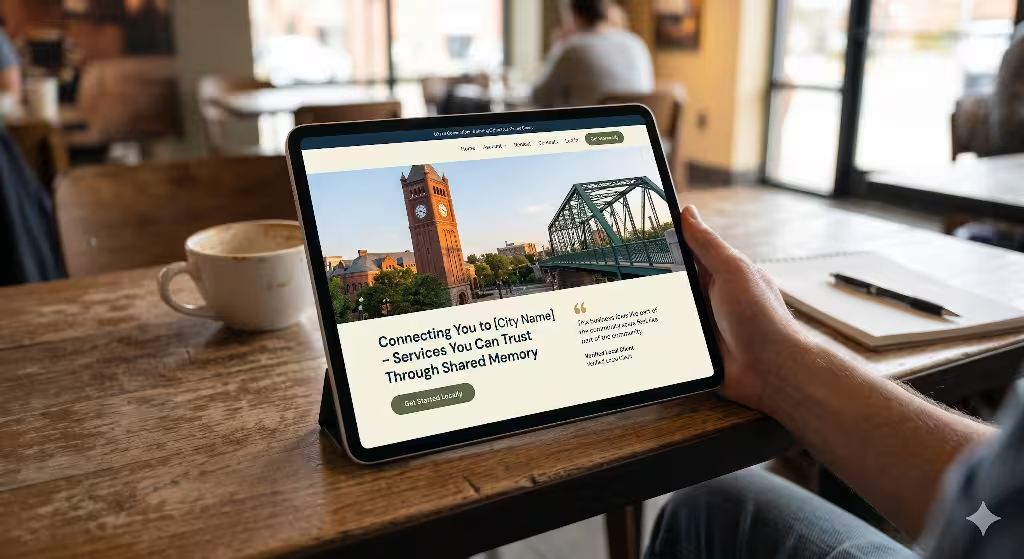
Landmarks serve as visual shortcuts. When a user lands on your page and sees a high quality image of a recognizable local landmark, their brain instantly answers several questions:
- “Where is this business located?”
- “Is this business relevant to my area?”
- “Can I trust them?”
The user does not have to hunt through a long “About Us” page or dig into the footer to find an address. The landmark tells them everything they need to know in a fraction of a second. By lowering the mental effort required to understand your business, you create a smooth user experience. This comfort directly benefits your online brand identity, making users more willing to stay on your site, read your content, and fill out your contact forms.
The “Terroir” of Digital Space
The word terroir comes from agriculture. It describes how the specific environment, soil, and climate of a region give a product like wine or honey its unique flavor. You cannot replicate the terroir of one region in another. In design, we can use the concept of digital terroir to create an online brand identity that feels entirely native to your specific geographic location.
Creating digital terroir means your website design is shaped by the physical realities of your region. If your business is in a historic coastal town, your online brand identity should reflect the weathered wood, coastal stones, and maritime architecture of that area. If you are in a bustling desert city, your design should reflect the warm earth tones and sharp geometries of the local landscape.
This approach prevents your online brand identity from feeling like a copy-and-paste job. It gives your website an organic flavor that feels completely right to local users. They feel a sense of shared memory and belonging when they browse your site, because the digital space mirrors the physical world they love.
Can using local landmarks improve user trust and website conversion rates?
Yes, using local landmarks can greatly improve user trust and website conversion rates. A conversion rate is the percentage of website visitors who take a desired action, like buying a product or signing up for a newsletter. Trust is the single most important factor in driving conversions, and local landmarks are powerful trust builders.
When a website features real photos or custom graphics of local landmarks, it signals honesty. It tells the customer that you are not a scams-by-mail operation or a hidden company hiding behind a fake address. You are a real business with a real presence near a landmark they know well.
This boost in trust directly influences user behavior:
- It reduces bounce rates, meaning fewer people leave the site immediately after arriving.
- It increases the time spent on the site, allowing users to connect with your brand.
- It makes users feel safer entering their credit card or contact information.
By anchoring your online brand identity to the landmarks your customers already love, you remove the fear of the unknown and pave a clear path to higher sales and leads.
Operationalizing the Blueprint: Practical Implementation Matrix
The Visual Asset Audit
To successfully build your online brand identity around local landmarks, you must start with a visual asset audit. This means you need to carefully look at your local area and select the best landmarks to feature on your website. Do not just pick the biggest or most famous building without thinking it through. The landmarks you choose must align perfectly with your business values and what your brand stands out for.
Start by making a list of major structural and natural landmarks within your service area. Evaluate each one based on three key traits:
- Visibility: Is the landmark widely recognized by the local population?
- Contrast: Does it have a unique shape or look that stands out visually?
- Alignment: Does the landmark match your brand’s message? (For example, an innovative tech company might align better with a modern local bridge, while a law firm might match a historic brick courthouse).
Once you select your landmarks, gather high quality assets. Avoid using generic stock photos of the landmark. Instead, invest in custom photography or professional illustrations that match the color palette of your online brand identity. This ensures that the visuals feel integrated into the design, rather than look like an afterthought.
Interface Localization Strategy
Once you have your visual assets, you need an interface localization strategy. This is the plan for how and where you will display these local landmarks on your website to reinforce your online brand identity. You want the landmarks to be noticeable but not distracting. They should support the user experience, not clutter it.
The best places to weave landmarks into your website interface include:
- The hero section: The very top of the homepage is prime real estate. A beautiful background image or custom illustration of a local landmark instantly sets the stage for your online brand identity.
- The footer: Placing a stylized skyline or landmark icon at the bottom of every page acts as a visual anchor that ties the entire site together.
- Location pages: If your business serves multiple towns, give each town its own specific page. Feature a landmark unique to that specific town on its page to show deep local knowledge.
For advanced websites, you can use dynamic content rendering based on user geolocation. This means the website detects where the user is browsing from and automatically swaps out the background landmarks to match their specific town. This level of customization creates an incredibly powerful and personalized online brand identity.
Pitfalls to Avoid
While using local landmarks can transform your online brand identity, there are several dangerous pitfalls you must avoid. The first mistake is using fake or inaccurate landmark associations. Never claim to be right next to a famous landmark if your office is actually fifty miles away. Users will quickly catch on to this dishonesty, and it will permanently damage your online brand identity.
Another major pitfall is over-cluttering your UI, which stands for user interface. It is easy to get excited and throw every local landmark onto your homepage. This creates visual noise and increases cognitive load, which defeats the entire purpose of the design. Stick to one or two primary landmarks and use them cleanly.
Finally, keep an eye on legal and copyright rules. Some historic buildings, private parks, and modern monuments have trademark protections or specific rules about using their likeness for commercial branding. Always make sure you have the right to use an image or illustration before publishing it as a core part of your online brand identity.
The Evolution of Place-Based Digital Architecture
The future of web design belongs to businesses that understand how to blend physical reality with digital spaces. A strong online brand identity cannot survive by being generic and placeless. By intentionally using local landmarks as cognitive, visual, and technical anchors, you transform your website into a living digital extension of your community.
This place-based digital architecture respects the natural way human brains navigate and build trust. It uses the evolutionary principles of biophilic design to create web environments that feel calming, familiar, and authentic. At the same time, it leverages advanced local SEO mechanics to ensure your business remains highly visible to search engines and local customers alike.
Building an online brand identity around the landmarks of your region is not just a passing trend. It is a timeless design strategy rooted in human psychology, architectural history, and digital engineering. When you anchor your digital presence to the permanent structures of the real world, you build an online brand identity that is stable, memorable, and ready to thrive for years to come.
Strategic Implementation Worksheet
To help you put these concepts into immediate action for your own online brand identity, use the following structured table to map out your local spatial anchoring and technical SEO integration.
| Implementation Phase | Strategic Action Steps | Primary Objective | Key Deliverables |
| 1. Geographic Auditing | Identify 3 high-prominence local landmarks within your core service radius. Evaluate them based on regional recognition, visual contrast, and structural symmetry. | Select ideal physical anchors to align with your online brand identity. | A finalized list of targeted regional landmarks with verified geographic coordinates. |
| 2. Asset Production | Capture custom, high-resolution photographs or create vector illustrations of the selected landmarks using your brand’s core color palette. | Eliminate generic stock imagery to enhance visual authenticity across your digital footprint. | A dedicated asset library consisting of hero backgrounds, footer silhouettes, and custom icon sets. |
| 3. Technical Schema Setup | Write custom LocalBusiness JSON-LD Schema code. Use the knowsAbout and sameAs properties to link your site directly to the Wikipedia or Wikidata entries of the landmarks. | Programmatically define your location data for search engine knowledge graphs. | Verified Schema script injected into your website header and tested via structural data tools. |
| 4. Interface Integration | Deploy the visual assets into the website hero section, location landing pages, and global footer. Keep layout white space balanced to avoid visual clutter. | Reduce user cognitive load by providing immediate visual confirmation of your service area. | A fully optimized, place-based user interface that improves spatial orientation and navigation. |
| 5. Copywriting Alignment | Review and update web copy to include local brand linguistics, landmark-based navigation cues, and regional neighborhood naming conventions. | Deepen cultural semantics and match the natural search vocabulary of local consumers. | SEO-optimized web copy that builds immediate trust and enhances local keyword relevance. |