
Table of Contents
Foundational Concepts
The Digital Monoculture Myth
Many people think the internet is a universal space where everyone acts the same way. This belief is what we call the digital monoculture myth. It is the idea that a single website design can work perfectly for every user in every country. Companies often build a website that succeeds in New York or London, and they assume it will work just as well in Tokyo, Mumbai, or Cairo. They believe that because the underlying technology is the same, human behavior will be the same too.
This assumption is a major mistake. When you build a digital storefront, you are not just writing code. You are speaking to human beings. Human beings do not live in a vacuum. Every person who opens a web browser is guided by their own cultural context. This cultural context shapes how they view colors, how they read pages, and how they decide whether to trust a business.
If you ignore the cultural context of your audience, your website will feel alien to them. They will not understand your layout, they will feel uneasy about your checkout process, and they will ultimately leave your site without buying anything. The internet is not a single culture. It is a massive collection of different human experiences.
Digital Ecosystem Theory
To build better websites, we should look at web design through the lens of nature. In the physical world, plants and animals adapt to their specific environments. A cactus thrives in a dry desert, while a fern needs a damp forest. If you swap their environments, they will die. Websites operate in a similar way. We can call this idea Digital Ecosystem Theory.
A website is like a living organism, and the internet is its environment. The users who visit the site form the local ecosystem. The most important factor in this digital ecosystem is the cultural context of the users. A website must adapt to the cultural context of its market if it wants to survive and grow. For example, a minimalist design with lots of white space might thrive in a Scandinavian ecosystem.
However, that same minimalist design might fail completely in an East Asian ecosystem, where users expect a high density of information and vibrant visuals. When you design with the ecosystem in mind, you make sure your website fits naturally into the daily lives of your users. You stop fighting against their habits and start working with them.
Defining the Path Forward
If you want to scale your e-commerce business globally, you cannot rely on luck. You need a clear, scientific plan. To achieve sustainable global growth, you must match your website interface and mechanics to the cultural context of your target market. You need to align your layout, your imagery, your navigation, and your payment options with what your local users already expect.
This article will show you exactly how to do that. We will explore how deep human values influence web design. We will look at data frameworks that help us understand different user behaviors across the globe. We will also look at the technical side of things, making sure your site can be found by search engines in different countries. By the end of this guide, you will know how to analyze any market, understand its unique cultural context, and build an e-commerce platform that feels local, trustworthy, and ready to convert visitors into loyal customers.
Anthropological Frameworks Applied to E-Commerce Interfaces
Hofstede’s Cultural Dimensions Matrix
To understand how cultural context changes the way people shop online, we can use tools from anthropology. One of the best tools is Hofstede’s Cultural Dimensions Matrix. This framework helps us measure and compare the core values of different societies. When we apply these dimensions to web design, we can see exactly why certain layouts work in one country but fail in another. Let us break down three of the most important dimensions that affect e-commerce websites.
Individualism vs. Collectivism
The balance between individualism and collectivism is a major part of the cultural context of any society. Some cultures value the independent individual, while others value the connected group. This difference changes how people make buying decisions online.
In highly individualistic societies, like the United States or Australia, the cultural context places the focus on personal choice and self-improvement. When people shop online in these markets, they want to see how a product will help them personally. They like interfaces that highlight unique features, custom options, and personalized rewards. Web designs should focus on isolated product highlights. You should give the user plenty of control over their experience, allowing them to filter products easily and customize their profile.
Individualistic Layout:
[ Product Image ] -> [ Custom Options / Colors ] -> [ "My Personal Rewards" ]

Collectivist Layout:
[ Product Image ] -> [ "10,000 People Bought This" ] -> [ Community Reviews Feed ]
In collectivist societies, such as Japan or South Korea, the cultural context is very different. People in these markets view themselves as part of a larger community. Their buying choices are deeply connected to social harmony and group approval. If you design a website for a collectivist culture, you must emphasize group validation.
Your layout should feature prominent community feeds, social proof tools, and regional customer testimonials. Users want to see that many other people have bought and approved of the item. Showing that a product is a “best seller” or “trusted by millions” is much more effective than simply saying it is unique. Your interface needs to feel like a shared space where the community agrees on the value of the product.
Power Distance Index (PDI)
The Power Distance Index, or PDI, measures how much a society accepts inequality and hierarchy. In some places, people respect official authority figures and strict structures. In other places, people prefer flat organizations and casual relationships. This aspect of cultural context changes how you build trust on a website.
In high-PDI cultures, like Malaysia or Saudi Arabia, the cultural context dictates a respect for official power, experts, and established rules. Web design for these markets must project strong authority signals. Your site should display official expert certifications, clear structural hierarchies, and formal language. The navigation should be top-down and highly structured. Users feel safe when they see that a website is backed by recognized organizations, top tier rewards, or well known figures. They want to know exactly who is in charge and that the business follows a strict, formal process.
In low-PDI cultures, like Denmark or New Zealand, the cultural context favors equality and informal setups. Users in these markets do not care about fancy titles or official badges. In fact, too many corporate badges might make them suspicious. They prefer a flat, interactive architecture where they can challenge information and look at peer-to-peer reviews. The tone should be casual and friendly. Trust is built through transparency and direct communication, not through top-down declarations of authority.
Uncertainty Avoidance Index (UAI)
The Uncertainty Avoidance Index, or UAI, measures how comfortable people are with risk and ambiguity. Some cultures hate surprises and want everything planned out perfectly. Other cultures are happy to explore, take risks, and try new things. This factor of cultural context tells you how much detail you need to include on your pages.
In high-UAI cultures, like Greece or Japan, the cultural context means people feel highly anxious when faced with unknown situations. When they shop online, they need complete certainty. If your website leaves out details, they will abandon their shopping carts instantly. To serve high-UAI users, you must provide total transparency. Your checkout funnel must show every single cost upfront, including shipping fees and taxes.
You need to place clear, explicit links to your return policies on every page. You must use comprehensive trust badges and detailed FAQ sections. The design should avoid sudden pop-ups or unexpected layout changes. Every step of the buyer’s journey must be predictable and secure.
High-UAI Checkout Flow:
[ Cart Total ] -> [ Exact Shipping Cost ] -> [ Tax Breakdown ] -> [ Clear Return Policy Link ] -> [ Confirm ]

Low-UAI Checkout Flow:
[ Cart Total ] -> [ Express Pay Button ] -> [ Success ]
In low-UAI cultures, like Great Britain or Sweden, the cultural context allows for a higher tolerance of ambiguity. Users are more willing to click around and explore a site, even if they do not know exactly where a link leads. You can use experimental micro-interactions, minimal text overhead, and a sleek, artistic layout. They do not need to see a wall of text explaining the return policy on the homepage. They trust that things will work out, or they will simply figure it out as they go along.
Quantitative Cross-Border UX Reference Matrix
When designing an e-commerce platform for different regions, you need quick, reliable data to guide your choices. The table below connects specific profile traits to user interface preferences. It also shows which e-commerce components are most affected by these choices.
| Cultural Dimension Profile | User Interface Preference | Targeted E-Commerce Component |
| High Uncertainty Avoidance | High data density, structured FAQs, upfront pricing breakdowns | Cart, checkout funnel, payment gateway options |
| Collectivist | Peer reviews, social sharing integration, community imagery | Product Detail Pages (PDP), user-generated content sections |
| High-Context Communication | Visual complexity, layered graphics, contextual imagery | Homepage layout, hero banners, site exploration loops |
| Low-Context Communication | Minimalist aesthetic, explicit copy, direct call-to-actions | Navigation menu, global filters, internal site search |
Analyzing the Matrix
Let us look closely at how this reference matrix applies to real web design scenarios. When a culture has a high uncertainty avoidance profile, the cultural context requires you to focus on the cart and checkout areas. You cannot use vague phrases like “Shipping calculated later.” You must build real-time calculation tools into the shopping cart. You should also offer multiple local payment options so the user feels safe using a system they already know and trust.
For collectivist profiles, the focus shifts to the Product Detail Pages. The cultural context demands that you show how other people feel about the product. Do not just list the technical specs. Include a robust review section where users can upload photos of themselves using the product. Add buttons that make it easy to share the item with friends and family on local messaging apps.
When dealing with high-context communication profiles, your homepage needs to change completely. The cultural context here appreciates deep meanings, visual stories, and dense information. You should use rich graphics, detailed banners, and layered layouts that tell a story.
On the other side, low-context communication profiles want the exact opposite. Their cultural context values directness and speed. If they land on a page, they want to find what they need in seconds. You should give them a powerful internal search bar, clear navigation filters, and text that tells them exactly what to do next.
Spatial Chromatics

Chromatics and Color Psychology
Color is one of the first things a user notices when they visit a website. It sets the mood instantly. However, the meaning of a color can change completely depending on the cultural context of the viewer. There is no such thing as a universally safe color. A shade that represents happiness in one region might represent sadness or bad luck in another.
Let us look at the color white. In Western cultural context, white is often linked to cleanliness, simplicity, and modern luxury. Tech companies use white space to make their brands feel expensive and high-tech.
However, in many East Asian traditions, white is the color of mourning and funerals. If you use too much cold white on an e-commerce site in that region, it can create a subconscious feeling of loss or discomfort.
Color Meanings by Cultural Context:
Red   -> Western: Danger/Passion | East Asian: Luck/Wealth/Success
White -> Western: Luxury/Clean   | East Asian: Mourning/Funerals
Blue  -> Western: Corporate/Trust| Global: Generally stable, but varies in depth
Now consider the color red. In Western markets, red can mean danger, error, or an emergency. It is often used for stop signs or error messages.
But if you look at the cultural context of China or Vietnam, red is the ultimate color of luck, wealth, and success. An e-commerce site during a holiday season in those countries will be covered in bright red to invite customers to spend money and celebrate.
If you are expanding to Germanic markets, you will find that silver and muted tones build the most trust, as they relate to high-quality engineering and reliability. You must always research what your color choices mean within the local cultural context before you build your style sheets.
Composition and Biophilic Anchors
Spatial composition refers to how you arrange items on a screen. Some cultures prefer clean, empty spaces, while others like dense spaces full of action. This preference is deeply tied to how people interact with their physical environments. We can learn a lot by looking at how different societies build their cities and live with nature.
In low-context, Western cultures, people prefer clean layouts with clear boundaries. The cultural context prioritizes focus. Users want to see one clear item at a time. Whitespace is used as an active design element to separate ideas and products. This style matches a lifestyle that values individual focus and linear tasks.
In high-context cultures, the cultural context embraces density and interconnectedness. If you look at a major city street in Tokyo or Taipei, you will see a massive amount of visual information, including neon signs, text, symbols, and crowds. This density carries over into the digital world.
Users from these regions often feel that an empty website looks abandoned or untrustworthy. They want to see a rich layout packed with product options, moving banners, text links, and live updates. They are excellent at scanning dense layouts to find what they need.
We can also use biophilic anchors, which are design choices inspired by nature, to bridge these gaps. Nature organizes information in complex but orderly ways. Think of a coral reef or a dense forest canopy. There is a lot happening, but it feels balanced.
By using natural patterns, soft textures, and organic lines, you can create a layout that feels alive and welcoming. For high-context markets, you can use a dense but organized natural pattern. For low-context markets, you can use a single, striking natural image to anchor the page. Adapting your space to the local cultural context ensures that your users feel comfortable the moment they arrive.
Information Architecture and Cognitive Processing

Monochronic Environments
The way people think about time and information changes across different societies. Anthropologists split these viewpoints into two main categories: monochronic and polychronic. These categories are a critical part of the cultural context of your users, and they change how you should build your website navigation.
Monochronic cultures include countries like the United States, Germany, and the United Kingdom. In these regions, the cultural context treats time as a straight line. Time is a limited resource that can be spent, saved, or wasted. People like to do one thing at a time, in a strict order. They value speed, efficiency, and punctuality.
When you design an e-commerce site for a monochronic audience, your information architecture must be perfectly linear. The customer journey should follow a straight line from discovery to purchase.
Monochronic User Journey (Linear):
[ Search Product ] -> [ View Simple Page ] -> [ One-Click Add to Cart ] -> [ Quick Checkout ]

Polychronic User Journey (Networked):
[ Browse Homepage ] -> [ Open Multi-Tabs ] -> [ Compare live deals ] -> [ Chat with support ] -> [ Buy ]
Your navigation headers must be clean and simple, using clear categories like “Men’s Shoes” or “Kitchen Tools.” Do not distract the user with unexpected pop-ups or sidebar deals that have nothing to do with their search.
The checkout funnel should be as fast as possible, ideally offering one-click checkout options. Every extra step you add to the process creates friction for a monochronic user, causing them to leave your site because they feel you are wasting their valuable time.
Polychronic Environments
Polychronic cultures include regions like Latin America, the Middle East, and parts of Southern Europe and Asia. In these societies, the cultural context views time as a fluid, cyclical web. People are completely comfortable managing multiple tasks at the exact same time. Relationships and interactions matter much more than strict schedules or fast, automated transactions.
For a polychronic audience, a linear, minimalist website can feel cold, uninviting, and even broken. The cultural context demands a multi-threaded, rich experience. Your website layout should allow for multiple exploration loops. You can include animated UI elements, live customer service chat widgets that pop up to offer help, and concurrent promotional feeds running down the side of the page.
Look at a popular e-commerce platform like Rakuten in Japan. To a Western eye, it looks overwhelming because it features dozens of fonts, bright colors, blinking alerts, and countless banners all on one screen. But to a Japanese user, this density matches their polychronic cultural context. It feels like a busy, exciting, trustworthy marketplace. It gives them the freedom to explore multiple options at once, chat with sellers, compare deals, and make a decision at their own comfortable pace.
Frequently Asked Questions about Cultural Context in E-Commerce
How does cultural context influence user experience design in e-commerce?
To understand how cultural context influences user experience design, we have to look closely at human psychology. Culture acts as a software program for the human brain. It tells us what is normal, what is beautiful, and what is safe. When a user lands on an e-commerce platform, their brain evaluates the page using rules they learned throughout their life.
If the cultural context of the website does not match the rules of the user, a deep psychological mismatch occurs. For example, consider the concept of trust. In some cultures, trust is built through clear, objective data, like technical specs and independent lab results. In other cultures, trust is built through emotional connections, history, and community approval.
If your website only shows data to a culture that values emotional connection, you will fail to build trust. This mismatch directly leads to high bounce rates, low engagement scores, and massive cart abandonment rates. Cultural context changes how users read screens, how they perceive layout balance, and how long they will wait for a page to load. It affects every single click on your site.
Western Trust Model:
Data + Independent Lab Results + Bullet Points = High Conversions

Eastern Trust Model:
Brand History + Peer Testimonials + Video Demos = High Conversions
What is the difference between localization and internationalization in web design?
Many business owners confuse these two important terms, but they represent very different steps in the development process. Internationalization is an engineering step. It is the process of building the backend architecture of your website so that it can support multiple languages, currencies, and data formats without breaking.
When you internationalize a site, you ensure that your code can handle right-to-left text for Arabic, or that it can display different currency symbols like Euros or Yen. You are preparing the digital shell for global use.
Localization is a design and content step that happens next. It is the process of adapting the actual aesthetic, spatial configuration, and interaction models to match local behavioral traits. Localization goes far beyond translating words from English to Spanish.
Localization means changing the images to reflect the local population. It means adjusting the layout density to fit the regional communication style. It means rewriting your marketing copy so that its humor and tone match the local cultural context. Internationalization gives your website the ability to travel the world, but localization gives your website the ability to feel at home when it arrives.
Why do global e-commerce platforms fail when ignoring local cultural nuances?
When a large e-commerce company enters a new country and fails, the cause is rarely bad technology. It usually fails because it ignored local cultural nuances. One of the most common friction points is the failure to support local payment infrastructure.
For example, in Germany, many shoppers prefer direct bank transfers through systems like Girocard or iDEAL rather than using credit cards. In Southeast Asia, cash-on-delivery systems are still incredibly popular because users want to hold the physical product before handing over their money. If a global platform arrives in these markets and only offers standard credit card inputs, it ignores the local cultural context around financial security.
Payment Preferences by Region:
North America -> Credit Cards / Digital Wallets
Germany       -> Direct Bank Transfers (Girocard/iDEAL)
Southeast Asia-> Cash-on-Delivery / Local E-Wallets
Another reason for failure is visual alienation. If a company uses inappropriate symbols, icons, or gestures in its imagery, it can offend or confuse local users. A simple thumbs-up icon means “good job” in the West, but it is an offensive gesture in parts of the Middle East.
Ignoring these details tells the consumer that the brand does not understand them or care about their lifestyle. When users feel alienated, they lose trust instantly and move to local competitors who understand their cultural context naturally.
Technical Architecture and Global Search Engine Optimization (SEO)
Hreflang Implementation Blueprint
To make sure your localized designs are visible to the right people, you must configure your technical SEO perfectly. Search engines need clear directions to understand which version of your website should be shown to different users around the world. The most important tool for this job is the hreflang attribute.
The hreflang attribute is a piece of code placed in your HTML header or your XML sitemap. It tells search engines like Google exactly which language and region a specific page is designed for.
If you have one page for English speakers in Canada and another page for English speakers in the United Kingdom, your hreflang tags must show the difference. This prevents search engines from flagging your localized pages as duplicate content, which would damage your search rankings.
Here is a clean layout example of how these tags should look in your website header:
HTML
<link rel="alternate" href="https://example.com/us/" hreflang="en-us" />
<link rel="alternate" href="https://example.com/gb/" hreflang="en-gb" />
<link rel="alternate" href="https://example.com/jp/" hreflang="ja-jp" />
<link rel="alternate" href="https://example.com/" hreflang="x-default" />
The x-default tag is an important fallback tool. It tells the search engine where to send users if their language and location settings do not match any of your specific regional tags. By setting up this technical blueprint, you help search engines guide users directly to the interface that matches their regional cultural context.
Infrastructure Optimization
A beautiful website is completely useless if it takes too long to load. Page speed is a major ranking factor for global search engines, and it is a key element of the user experience. When you serve a global audience, your physical website servers might be thousands of miles away from your users. This physical distance creates latency, which slows down your site.
To fix this issue, you must use a localized Content Delivery Network, or CDN. A CDN is a global network of servers that store copies of your website content. When a user in Tokyo visits your site, the CDN serves the data from a server located in Tokyo, rather than from your main server in Chicago.
User Request Flow with CDN:
[ User in Tokyo ] -------> [ Tokyo CDN Server (Fast Copy) ] -------> [ Immediate Load ]
                                  ^
                                  | (Syncs updates)
                                  |
                        [ Main Chicago Server ]
You should also look into server edge-rendering. This technology builds your web pages on the CDN server closest to the user before sending it to their browser. This approach keeps your Core Web Vitals strong, even in regions where internet speeds are slow or unstable.
Optimizing your infrastructure ensures that your site loads instantly, allowing your carefully planned cultural context design choices to shine without technical delays.
Alternative Search Engine Crawling
While Google is the dominant search engine in most parts of the world, it is not the only one. If you want to expand your e-commerce presence into markets like China, Russia, or South Korea, you must optimize your site for alternative search engines. Each of these platforms has its own unique crawling rules and indexing systems that reflect the cultural context of their domestic markets.
In China, Baidu is the leading search engine. Baidu operates within a specific regulatory environment. It prioritizes websites that use local .cn domains and servers hosted inside mainland China.
Baidu also has a difficult time reading JavaScript. If your website relies on complex JavaScript frameworks to load content, Baidu might see an empty page. You need to use server-side rendering to ensure its web crawlers can read your text.
Search Engine Optimization Targets:
Google -> Global standard, prioritizes core web vitals and mobile-first index.
Baidu  -> China market, requires local hosting, struggles with JavaScript.
Yandex -> Russia market, heavily emphasizes local user behavior signals.
In Russia, Yandex is highly popular. Yandex places an enormous amount of weight on user behavior signals, such as how long a visitor stays on your site and whether they interact with your contact pages.
In South Korea, Naver is the primary tool for search. Naver functions more like an information portal than a simple list of web links. It groups search results by blogs, community forums, cafes, and shopping centers.
To rank well on Naver, you must format your structured schema markup to match their unique platform categories. Understanding the technical requirements of these alternative networks is just as important as understanding the cultural context of the people who use them.
Case Studies, Conversion Analysis, and Strategic Summary
Empirical Global Audits
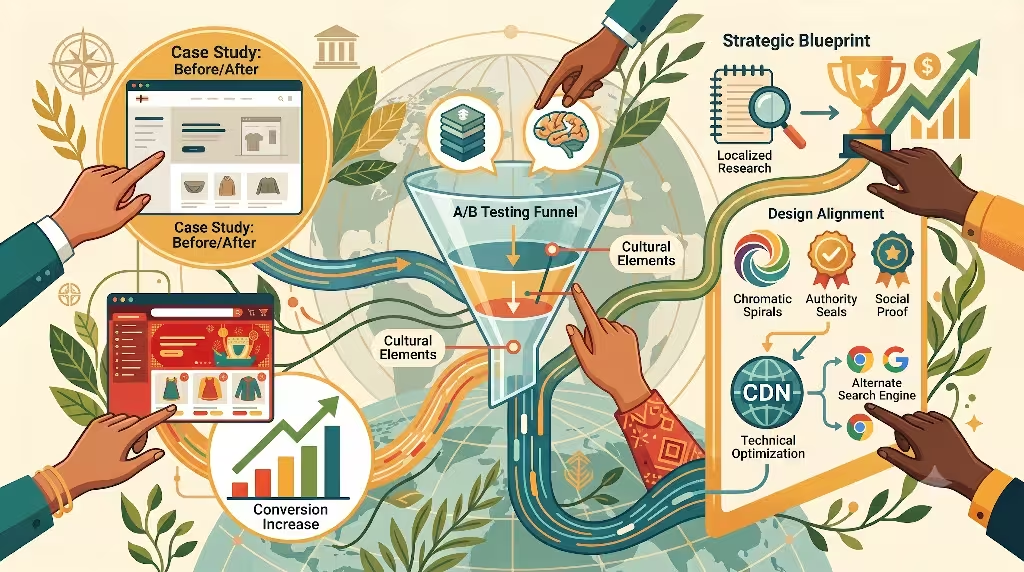
Let us look at real-world evidence to see how adjusting for cultural context changes business outcomes. A major electronic brand launched an international expansion strategy, moving their successful Western e-commerce store into the East Asian market. At first, they kept their original design, which featured a sleek layout, large images, minimal text, and massive amounts of white space.
The launch was a failure. For six months, their conversion rates stayed near zero, while their cart abandonment rates skyrocketed. The company decided to run an empirical global audit to find out what was wrong.
They ran user testing groups in Tokyo and Seoul. The feedback was clear: local users found the minimalist site untrustworthy, confusing, and empty. They felt the brand was hiding information because there were no detailed product specifications or live community reviews on the page.
Western Layout Audit: Minimal text -> High bounce rates in Asia
Asian Redesign Audit: High information density -> 40% Increase in Conversions
The brand immediately redesigned their platform for the East Asian market. They increased the information density by 300%. They added layered navigation menus, colorful promotion badges, scrolling text updates, and an extensive peer-review forum on every product detail page.
The results were immediate. Within three months of launching the culturally localized interface, their conversion rates increased by over 40%, and their customer acquisition costs dropped significantly. This case study shows that formatting your site to match the local cultural context is a direct driver of profitability.
The Global E-Commerce Diagnostic Checklist
Before you launch your website in a new international market, you should run it through this five-point structural checklist. This diagnostic tool will help you ensure that your platform design aligns with the expectations and values of your new audience.
- 1. Visual and Chromatic Verification: Have you thoroughly researched the meanings of your primary website colors within the target region? Are you certain that your use of whitespace and color combinations matches local expectations and does not trigger negative cultural associations?
- 2. Information Architecture Alignment: Is your site structure built to match the time and attention patterns of the local market? Does it use a fast, linear path for monochronic users, or does it offer an open, multi-threaded exploration ecosystem for polychronic consumers?
- 3. Social Proof and Trust Optimization: Does your product detail page highlight the correct trust signals? Have you prioritized individual rewards for individualistic cultures, or have you integrated community feedback loops and prominent social validation for collectivist societies?
- 4. Localized Payment and Checkout Infrastructure: Have you integrated the region’s preferred local payment networks, such as direct bank transfers, local e-wallets, or cash-on-delivery options? Is your pricing breakdown completely transparent from the first step of the cart funnel to satisfy high uncertainty avoidance markets?
- 5. Technical SEO and Discovery Compliance: Are your
hreflangtags correctly configured across all regional subfolders to prevent duplicate content issues? Is your content properly rendered on the server side so that alternative local search engines can crawl and index your site efficiently?
Final Strategic Summary
Building a successful global e-commerce business requires a deep respect for human diversity. You cannot treat the international market as a single, uniform audience. The way people navigate websites, look at pictures, process information, and choose to buy products is deeply rooted in the cultural context of their upbringing.
By using proven sociological models like Hofstede’s dimensions, you can move away from guesswork and build digital storefronts based on real human data.
Sustainable Global Scalability Model:
[ Local Cultural Context Research ]
                │
                ▼
[ Spatial & Visual Design Alignment ]
                │
                ▼
[ Technical Optimization (Hreflang / CDN) ]
                │
                ▼
[ High Trust & Maximum Conversions ]
When you combine culturally localized design with top-tier technical SEO practices, you create a powerful digital platform. You make your site easily discoverable by regional search engines, and you make it immediately comfortable for regional users.
As you continue to expand your digital footprint, remember to treat your website as an adaptive organism. Listen to your local metrics, respect the local ecosystem, and always design with the local cultural context at the center of your strategy. This approach is the true secret to building a globally scaled brand that wins trust and drives sales in every corner of the world.