
At Silphium Design LLC, we believe that a website should be more than just a screen with buttons. It should feel like a real place. In biology, we study how living things relate to their environment. In design, we call this the Genius Loci, or the spirit of a place. When we build a website for a local business, we want to capture that spirit. We want the digital world to feel like the physical world.
One of the best ways to do this is by using local history. This creates a deep bond between the user and the site. It is like planting a tree that has deep roots in the community soil. However, this task is not easy. There are many Challenges of Incorporating Local History into Web Design that we must face. We have to balance old stories with new technology. We have to make sure the facts are right. We have to make sure the site stays fast and easy to use. This article will explore these hurdles and show you how to jump over them.
Table of Contents
The Research and Verification Bottleneck
When you start adding history to a site, you must be a bit like a detective. You cannot just guess. If you put the wrong date or the wrong name on a website, people will notice. This hurts the trust they have in the brand. This is one of the biggest Challenges of Incorporating Local History into Web Design. You have to find real facts that are interesting and true.
How do you research local history for a website? You should start by looking at primary sources. These are things like old newspapers, diary entries, and official records. You can find many of these at the Digital Public Library of America. You can also visit local libraries or town halls. These places often have boxes of old photos and papers that are not on the internet yet. Talking to community leaders or elderly people in the town is another great way to get oral histories. These stories add a human touch that you cannot get from a book.
The bottleneck happens because this takes a lot of time. Most web designers want to work fast. They want to pick a color and a font and move on. But researching historical heritage takes weeks. You have to check facts against multiple sources. If one book says a building was built in 1890 and another says 1892, you have to find out which one is right. Dealing with these facts is part of the Challenges of Incorporating Local History into Web Design. You are building a digital repository for the town. That is a big responsibility. You are not just a designer anymore. You are a historian too.
The Aesthetic Conflict: Heritage vs. Modern UI
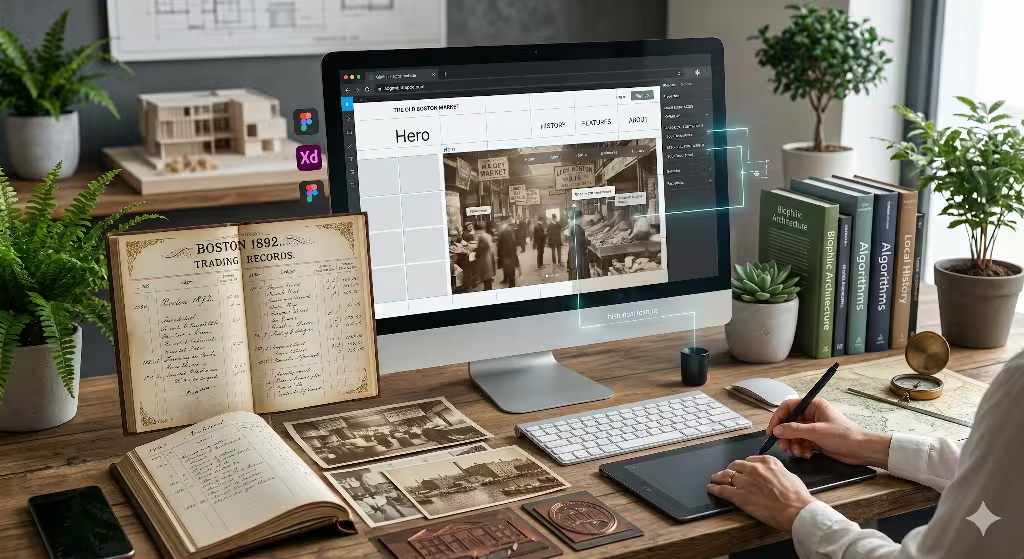
Web design moves very fast. Modern styles change every year. Right now, most people like clean lines and lots of white space. But local history is often messy. It is full of old textures like stone, wood, and yellowed paper. Trying to fit these two things together is one of the major Challenges of Incorporating Local History into Web Design.
How to balance modern UI with historical elements? You have to be careful not to make the site look old fashioned in a bad way. If you use too many old effects, the site might look like a school project from 1995. This is what we call the kitsch trap. To avoid this, you should use historical accents instead of making the whole site look old. For example, you might use a modern layout but pick a font that was popular in that town 100 years ago. You can use textures as backgrounds for small sections. This gives the site a feeling of place without making it hard to read.
Visual storytelling is the key here. You want to guide the user through a narrative. You can use heritage branding to tell the story of the business. If a bakery has been in a family for four generations, the website should show that.
But the buttons still need to be easy to find. The menu still needs to work on a phone. The design hierarchy must stay clear. If the history gets in the way of the user doing what they came to do, the design has failed. Managing this balance is one of the daily Challenges of Incorporating Local History into Web Design. We want the user to feel the past while they are using the tools of the future.
Technical Infrastructure and Performance Optimization
One thing I learned is that speed is everything on the internet. People will leave a site if it takes more than three seconds to load. This brings us to another one of the Challenges of Incorporating Local History into Web Design. Historical assets are usually very heavy.
When you get a scan of an old map or a high resolution photo from an archive, the file size is huge. These files are often TIF or large JPG images. If you just upload them to the site, the site will be very slow. This will hurt your SEO and frustrate your visitors. To solve this, you have to use modern image handling. You should convert these old images into new formats like WebP or AVIF. These formats make the files small but keep them looking sharp.
You also have to think about how you store the information. This is called metadata. You should use a system like Dublin Core to label your historical photos. This makes them easy for search engines to understand. It also helps if you have a lot of items on your site. If your site has a digital archive of 500 old photos, you need a way to organize them. This technical work is hidden from the user, but it is one of the core Challenges of Incorporating Local History into Web Design. Without good performance, the history is just a burden on the server.
Legal, Ethical, and Accessibility Constraints

Using history is not just about looks and speed. It is also about rules and respect. There are many legal and ethical Challenges of Incorporating Local History into Web Design. Just because a photo is old does not mean it is free to use. You have to check the copyright.
What are the legal issues with using historical photos online? Some photos are in the public domain, which means anyone can use them. Others have a Creative Commons license. But some are still owned by families or museums. You have to get permission before you put them on your site. If you do not, you could face legal trouble. This is a very important part of the Challenges of Incorporating Local History into Web Design. You must keep a record of where every image came from and who gave you permission to use it.
There is also the matter of ethics. Local history is not always happy. Every town has stories that are difficult or sad. When you design a site, you must be inclusive. You should look for stories from people who might have been left out of the history books in the past. This makes the site more authentic.
Finally, you must think about accessibility. We use the WCAG 2.2 rules to make sure everyone can use a website. This includes people who are blind or have low vision. If you use an old map, you must write a very good description for it in the alt-text. This allows a screen reader to tell the user what the map looks like. Making old, visual history accessible is one of the hardest Challenges of Incorporating Local History into Web Design. It requires a lot of extra writing and care.
The SEO Advantage: Entities and Local Authority
Now we get to the part that helps businesses grow. Even though there are many Challenges of Incorporating Local History into Web Design, the rewards are worth it. Google loves sites that have deep roots. When you talk about local history, you are using words that search engines use to understand where you are.
What are the benefits of using local history in web design? One of the biggest is entity linking. An entity is a real thing, like a person or a place. When your site mentions a famous local landmark or a historical figure, Google connects your site to that entity. This builds your local authority. It tells Google that you are a real expert in your area. This is great for local SEO.
To make this work, you should use schema markup. This is a special code that tells search engines exactly what a piece of text means. You can use LocalBusiness JSON-LD to tell Google about your building. You can use Event schema for historical tours. By doing this, you turn the Challenges of Incorporating Local History into Web Design into a competitive advantage. Most of your competitors will use generic templates with no history. Your site will stand out because it has geo-relevance. It feels like it belongs in the town. This helps with E-E-A-T, which stands for Experience, Expertise, Authoritativeness, and Trustworthiness. Google looks for these things when it decides who to show at the top of the search results.
Managing Scale in Heritage Projects

When you start a project like this, it is easy to get overwhelmed. You might start with one photo and end up with a thousand. Managing this growth is one of the logistical Challenges of Incorporating Local History into Web Design. You have to decide what is important and what is just noise.
In biophilic design, we look for patterns. We want to find the patterns that make people feel at home. In a website, history provides these patterns. But if you have too much history, the user will get lost. You have to be an editor. You have to choose the stories that best support the goal of the website. If the goal is to sell shoes, the history should be about how people in the town have always worked hard or walked these streets. It should not be a random list of facts. Keeping the site focused is one of the mental Challenges of Incorporating Local History into Web Design. You have to stay creative but also stay on task.
Why We Face the Challenges of Incorporating Local History into Web Design
You might ask why we go through all this trouble. Why not just use a pretty theme and some stock photos? The answer is simple. Stock photos have no soul. They could be from anywhere. A website with local history has a pulse. It connects to the people who live in that town. It makes them feel seen.
As someone who grew up in North Carolina and lives in Pennsylvania, I know how much people love their local roots. When we overcome the Challenges of Incorporating Local History into Web Design, we create something that lasts. We create a digital habitat. This is the goal of biophilic design. We want to bridge the gap between our screens and our world.
The Challenges of Incorporating Local History into Web Design are real. They require hard work and technical skill. You have to be a historian, a lawyer, a coder, and an artist all at once. But when you get it right, the result is beautiful. The site becomes a community fixture. It is not just a place to buy things. It is a place to learn and remember.
In the end, the Challenges of Incorporating Local History into Web Design are what make the work worth doing. They push us to be more innovative and competent. They force us to look closer at the world around us. By honoring the past, we build a better future for the internet. We make the web a more human place. That is why I love my job at Silphium Design LLC. We don’t just build sites. We plant digital gardens that grow from the rich soil of our history.
To wrap up, remember that the Challenges of Incorporating Local History into Web Design are about more than just old pictures. They are about data, speed, law, and people. If you take the time to do it right, your website will be a leader in its field. It will have the traffic and the trust that every business wants. Facing the Challenges of Incorporating Local History into Web Design is the best way to stand out in a crowded digital world.
Keep your images light. Keep your facts true. Keep your design modern but rooted. If you do these things, you will master the Challenges of Incorporating Local History into Web Design. You will create a site that people love to visit and search engines love to rank. It is a journey, but it is a journey through time and technology that is truly brilliant.
By following these steps, you can turn the Challenges of Incorporating Local History into Web Design into your greatest strength. Whether you are a small shop in a historic district or a large firm with a long legacy, your history is your power. Do not let the Challenges of Incorporating Local History into Web Design stop you. Use them as a guide to build something better. Use them to create a site that feels as natural and enduring as the land itself. That is the biophilic way. That is the way we design for the future by looking at the past.
The Challenges of Incorporating Local History into Web Design will always be there. But with the right tools and the right mindset, they are easy to solve. Start small. Find one great story. Find one great photo. Build from there. Soon, you will see how the Challenges of Incorporating Local History into Web Design disappear as your site comes to life. You will see your local SEO go up. You will see your users stay on the page longer. This is the power of place-based design. Facing the Challenges of Incorporating Local History into Web Design is the first step toward a more authentic and successful web presence.
Every town has a story. Every building has a past. When we bring these into the digital age, we honor the work of those who came before us. This is why we work through the Challenges of Incorporating Local History into Web Design. We do it for the community. We do it for the user. And we do it for the art of design. The Challenges of Incorporating Local History into Web Design are not obstacles. They are opportunities to be great. So, go find your local history and start building. The world is waiting to see what you create as you overcome the Challenges of Incorporating Local History into Web Design.