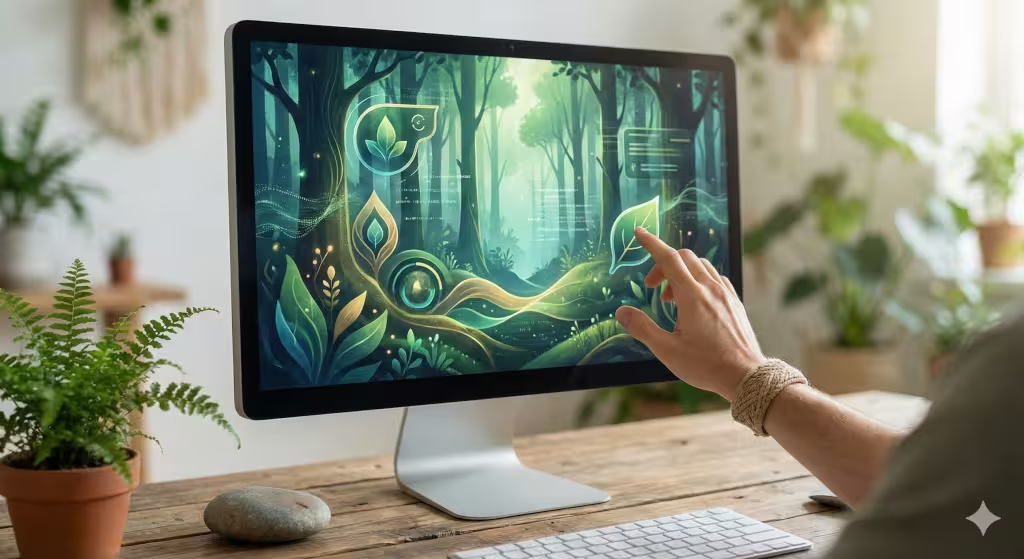
Have you ever walked through a deep, green forest and felt a sudden sense of peace? Your heart rate slows down. Your eyes stop darting around. You feel like you can finally breathe. Now, think about the last time you visited a messy, cluttered website full of flashing boxes and sharp, jagged edges. You probably felt the exact opposite. You felt stressed, tired, and ready to click away.
As a designer at Silphium Design LLC, I look at the internet through the eyes of a biologist. I went to Princeton to study how living things grow, and I went to Harvard to learn how computers think. What I discovered is that humans are not meant to live in a world of perfect squares and gray boxes. We evolved over millions of years to understand natural forms.
When we see the curve of a river or the shape of a leaf, our brains recognize it instantly. This is called biophilia. It is the idea that humans have an actual biological need to connect with nature. When we bring these natural forms into website design, we aren’t just making things look pretty. We are talking to the oldest part of the human brain. We are telling the user, “You are safe here. You can relax.”
In the 2026 digital world, where everything feels fast and robotic, using natural forms is the secret to making a brand feel real. It is the best way to keep people on your page and make them trust you. This article will show you how the world’s biggest brands are already doing this and why it works so well for your business.
Table of Contents
The Science of Cognitive Fluency and Organic Shapes
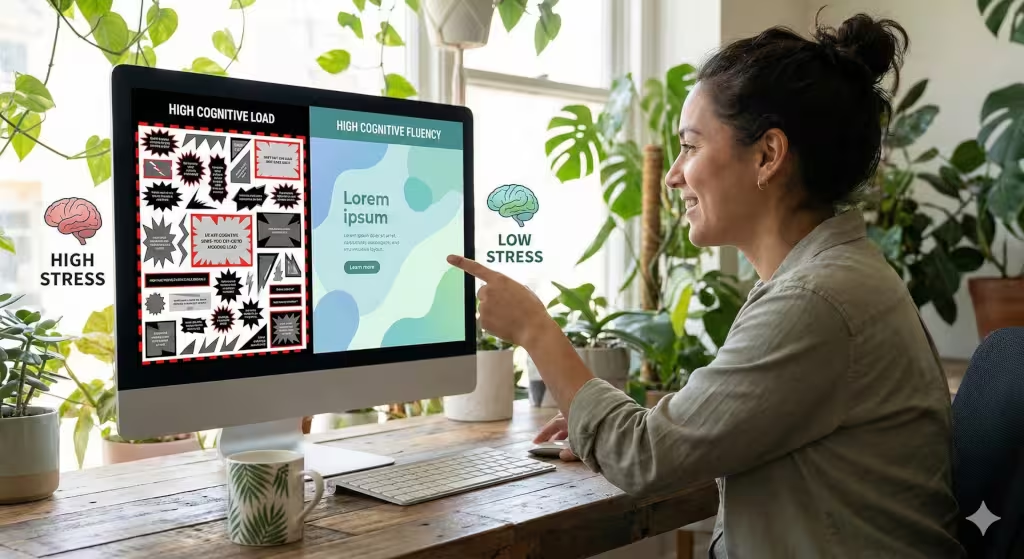
To understand why natural forms work, we have to look at how our brains process information. This is something scientists call cognitive fluency. Basically, it is a measure of how easy it is for your brain to understand what it is looking at.
Imagine two shapes. One is a perfect, sharp square. The other is a soft, flowing “blob” like a puddle of water. In nature, sharp angles are often a sign of danger. Think of a thorn, a jagged rock, or the teeth of an animal. Because of this, when our eyes see sharp corners on a computer screen, a tiny part of our brain stays on high alert. This creates “visual noise.”
Natural forms, on the other hand, are much easier for the brain to process. Most things in nature are curved. Your eyes can slide along a curve much faster than they can jump from one sharp corner to another. When a website uses these soft shapes, it lowers the “cognitive load.” This means the visitor doesn’t have to work as hard to use the site.
There is also a famous study called the Bouba/Kiki effect. Scientists showed people two shapes: one was rounded and bubbly, and the other was spikey and sharp. Almost everyone, no matter what language they spoke, felt that the rounded shape was “friendly.” By using natural forms, brands can actually make people feel like their software or their store is a friend instead of a machine.
Case Studies: Web-First Brands Leading the Natural Form Revolution
Some of the most successful companies in the world have already figured this out. They don’t use boring grids. They use the “flow” of nature to guide their users.
Spotify and the Power of the Blob
If you look at Spotify, you will notice that they almost never use simple rectangles for their background decorations. Instead, they use colorful, moving shapes that look like lava lamps or clouds. These are classic natural forms. Because music is something that moves and changes, these shapes help the user feel the “rhythm” of the app. It makes the experience feel active and alive.
Dropbox and the Hand-Drawn Touch
Dropbox used to be a very “techy” company. It felt cold. A few years ago, they changed everything. They started using illustrations that looked like they were drawn by a person, not a computer. They used wiggly lines and uneven shapes. These natural forms made the company feel more creative. It reminded people that behind all those files and folders, there are real human beings working together.
Calm and Visual Breathing
The app Calm is built entirely around nature. When you open it, you aren’t greeted by a list of buttons. You see a lake or a forest. The buttons themselves have rounded edges that mimic the soft stones you might find in a creek. By using natural forms, the app actually helps the user start to relax before they even start their meditation.
Cross-Channel Biophilia: From Architecture to the Screen
One of the coolest things about design is how it moves from the physical world to the digital world. We see this most clearly with brands like Apple and Patagonia.
Apple’s Big Circle
Apple is known for its clean design. But if you look closely, Apple loves natural forms. Their main headquarters in California, called Apple Park, is a giant circle. Inside, there are thousands of trees. If you visit their website or use an iPhone, you will see that almost every corner is rounded. In fact, they use a very specific kind of curve called a “squircle.” It is a shape that looks like a square but follows the mathematical rules of natural growth. This makes their high-tech gadgets feel like they belong in your hand.+1
Patagonia and the Raw Earth
Patagonia doesn’t try to make things look perfect. Their website uses textures that look like dirt, rock, and water. They use colors that you would see in a canyon or an ocean. By using these natural forms, they tell their customers that they care about the planet. You don’t just buy a jacket from them; you feel like you are joining a movement to save the outdoors.
The Amazon Spheres
Amazon built giant glass domes in Seattle full of plants from all over the world. They did this because they know that workers are more productive when they are around nature. Now, we are seeing more of these soft, organic shapes show up in how they design their digital icons and menus. They are trying to bridge the gap between a giant warehouse and a living garden.
Why Natural Design is a Secret Weapon for SEO
As a designer at Silphium Design LLC, I often have to explain to business owners that search engines are not just looking for keywords. They are looking for signals of quality. If you want to understand why natural forms are your secret weapon for ranking higher on Google, you have to understand how Google has changed. In the past, Google was like a librarian looking for a specific book title. Today, Google is more like a detective watching how people behave when they walk into a room.
When you use natural forms, you are creating an environment that encourages people to behave in ways that Google loves. This isn’t just a guess. It is based on the technical ways that search engines measure how “good” a website is. Let us break down the three main reasons why natural forms give you an unfair advantage in the world of search engine optimization.
Dwell Time and the Biological “Stay” Signal
The first major reason is something called dwell time. Dwell time is simply the amount of time a person spends on your website after they find it on a search engine. If a person clicks your link and then leaves five seconds later, Google thinks your page was not what they wanted. But if they stay for five minutes, Google sees a “success signal.”+2
This is where natural forms come in. As a biologist, I know that the human eye is constantly scanning for shapes that make us feel comfortable. When a user lands on a site that is full of natural forms, their brain sends a signal that it is safe to relax. Because the eye can easily follow the curves of natural forms, the user does not get tired as fast. Scientists call this “visual fatigue.” On a site with only sharp boxes, your brain has to work harder to figure out where one thing ends and another begins.
By using natural forms, you are actually lowering the mental energy it takes to read your site. This makes the user stay longer. When a user stays longer, your dwell time goes up. Google sees this and thinks, “Wow, people really like this site. I should show it to more people.” That is how natural forms help you climb to the top of the search results without you having to change a single word of your text.
Reducing Bounce Rates Through Immediate Trust
Another very important metric for SEO is the bounce rate. This is the percentage of people who leave your site after looking at only one page. A high bounce rate is like a red flag to a search engine. It says that your site is boring or hard to use.
Natural forms help reduce bounce rates by creating what I call “instant trust.” Research shows that it takes a person less than one second to decide if they trust a website. Because natural forms are associated with life and health, our brains automatically trust them more than cold, robotic shapes. When you use natural forms in your background, your buttons, and your pictures, you are using a visual language that humans have trusted for millions of years.
Think about it this way. If you walk into a store that has soft lighting and plants, you are more likely to walk around and see what they have. If you walk into a store that looks like a cold, gray prison cell, you probably want to walk right back out. The same is true for the internet. Natural forms act as a “welcome mat” for your website. They make people want to click on the next page, which lowers your bounce rate and tells Google your site is high-quality.
Core Web Vitals and Organic Efficiency
Now, let us talk about the more technical side. Google has a set of rules called Core Web Vitals. These rules measure how fast your site loads and how stable it feels. Some people worry that adding natural forms will make their site slow because “organic” sounds like “heavy.” But as a computer scientist, I can tell you that is not true.
In fact, natural forms can be very efficient. We use something called SVGs, which are like mathematical instructions for a shape. Instead of a huge, heavy photo of a leaf, we can use a tiny bit of code to draw natural forms that look beautiful and load in a split second. Because natural forms don’t have to be perfectly detailed to work, we can keep the file sizes small.
Also, natural forms help with “visual stability.” This is the “Cumulative Layout Shift” part of Google’s rules. When you have a lot of tiny, sharp boxes on a page, they often jump around as the page loads. But natural forms are more flexible. They can “flow” into place as the user scrolls, which makes the whole experience feel smoother. A site that loads fast and feels stable is a site that Google wants to rank. By using natural forms correctly, you are checking all of Google’s technical boxes while also making your site look modern and fresh.+1
The People-First Content Revolution
Finally, we have to talk about Google’s “Helpful Content System.” Google recently changed their rules to favor “people-first” content. They are tired of websites that are written just for robots. They want sites that feel like they were made by real humans for real humans.
Natural forms are the ultimate signal of a human touch. A robot can easily build a grid of squares. But it takes a real eye for design to incorporate natural forms in a way that feels balanced and artistic. When Google’s “detectives” scan your site, they see the use of natural forms as a sign that you care about the user experience.
It is a signal that you are not just trying to trick the computer, but that you are trying to provide a beautiful and helpful space. This builds what we call E-E-A-T, which stands for Experience, Expertise, Authoritativeness, and Trustworthiness. Using natural forms proves that you have the experience to understand what humans want. It shows your expertise in making a space feel right. This is why natural forms are not just a design choice. They are a core part of a winning SEO strategy in the modern age.
As we continue to build out our vision at Silphium Design LLC, we see that the brands that win are the ones that stop fighting nature and start working with it. Using natural forms is the best way to make sure that both humans and search engines fall in love with your website. It turns your digital space into a living ecosystem that grows on its own, attracting more visitors every single day.
Natural forms are the bridge between the old way of doing business and the new, “living” internet. When you embrace natural forms, you aren’t just following a trend. You are following the blueprint of life itself. And as any biologist will tell you, the things that follow nature are the ones that survive and thrive.
Common Questions About Natural Forms in Design
When people search for design tips, they often ask specific questions. Here are the answers based on the latest research in biophilic design.
What are examples of brands using natural forms effectively?
As we discussed, Apple uses “squircles” and circular architecture. Spotify uses fluid, “blob-like” shapes to match the flow of music. Patagonia uses raw textures and earth tones to match the rugged outdoors.
How does nature influence website design?
Nature influences everything from the colors we choose (greens, blues, and browns) to the way we arrange items on a screen. Instead of a stiff grid, nature-inspired design uses “asymmetry,” which means things aren’t perfectly balanced on both sides, just like a tree.
Why use organic shapes in web design?
Organic shapes stand out. Most of the internet is made of straight lines. When you use a natural form, it catches the eye. It also makes the brand feel more human, more caring, and less like a cold machine.
Does biophilic design improve conversion rates?
Yes. When people feel relaxed, they are more likely to make a purchase. Stress makes people want to “escape” a website. Comfort makes them want to “explore” it.
Technical Implementation: How to “Nature-ify” a Grid
How do we actually build these sites? We use math that comes from the natural world.
The Fibonacci Sequence
In nature, things grow in a specific pattern. You can see it in the spiral of a seashell or the way a sunflower’s seeds are arranged. This is called the Fibonacci sequence. We use this math to decide how big our headers should be or how much space to leave between pictures. When a website follows these natural forms of growth, it feels “right” to the human eye.
1, 1, 2, 3, 5, 8, 13, 21, …
Breaking the Grid
Most websites are built on a grid of 12 columns. It is very stiff. To use natural forms, we “break” the grid. We might have a picture of a leaf that overlaps two different sections. Or we might use a background shape that wanders across the page. This creates a sense of adventure, like walking down a trail where you don’t know what is around the next corner.
Fractals
Fractals are patterns that repeat at different sizes. Think of a fern leaf. One tiny leaf looks just like the whole branch. We can use this in design by repeating small shapes inside larger ones. This creates a sense of harmony and “visual interest” without making the page look messy.
Understanding the Elements of Natural Forms
To truly master this style, you have to look at the different parts of nature that we can copy.
- Botanical Shapes: These are shapes that look like leaves, petals, or branches. They are great for logos and icons.
- Animal Motifs: This isn’t just about drawing animals. it is about using textures like scales, feathers, or fur to give a website a “tactile” feel.
- Geological Forms: These are shapes that look like rocks, mountains, or crystals. They make a brand feel strong and permanent.
- Fluidity: This is the look of water or wind. It uses soft gradients and moving parts to make a site feel smooth.
The Future of the “Living” Internet
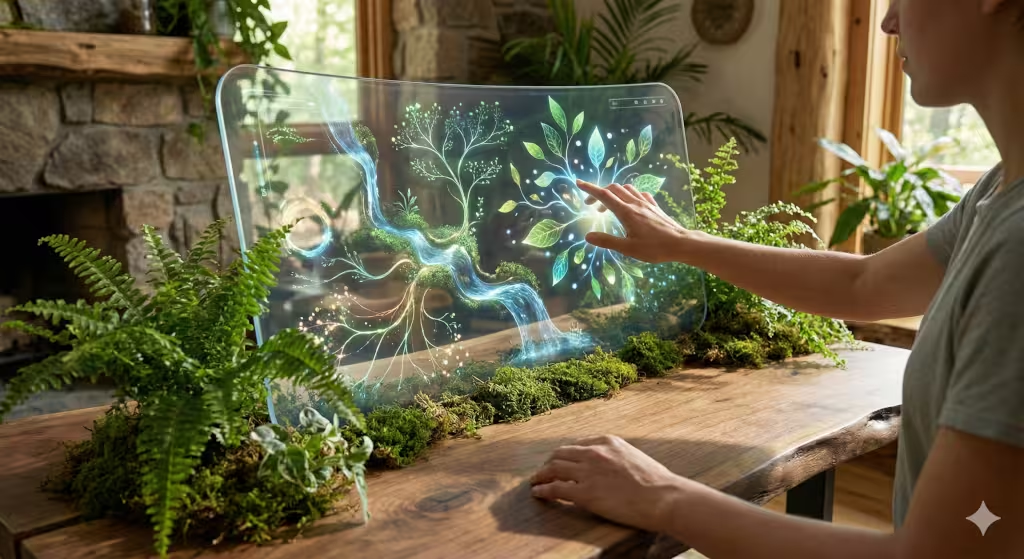
As we move further into 2026, the internet is changing. We are seeing more “generative” design, where AI creates shapes on the fly. But AI often creates things that are too perfect. The secret to great design is the “imperfection” of natural forms.
A real tree isn’t perfectly straight. A real river doesn’t flow in a straight line. By adding these tiny imperfections to our websites, we make them feel more “alive.” This is the future of Silphium Design LLC. We want to build a digital world that doesn’t feel like a computer screen, but like an extension of the natural world.
When a brand uses natural forms, they are making a promise to the user. They are saying, “We understand you. We know you are a living, breathing person, not just a data point.” In a world of cold technology, that is the most powerful message a brand can send.
Why Your Brand Needs a Natural Touch
We have seen many examples of brands using natural forms effectively. From the soft curves of an iPhone to the moving blobs on Spotify, these shapes are everywhere. They work because they speak to our biology. They make us feel calm, they help us process information faster, and they keep us coming back for more.
If your website feels stiff and old, it might be time to look outside. Look at the trees, the clouds, and the waves. There is a whole world of design ideas waiting for you in the great outdoors. By bringing those natural forms into your digital space, you won’t just look better, you will perform better in search engines and build a stronger bond with your customers.